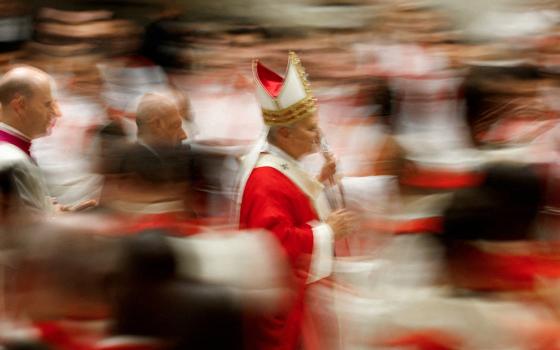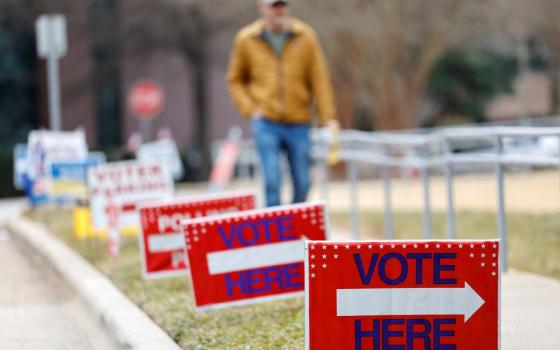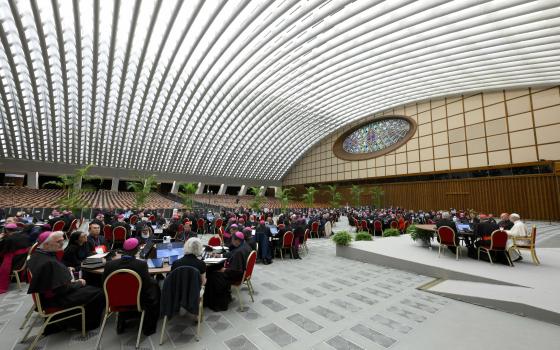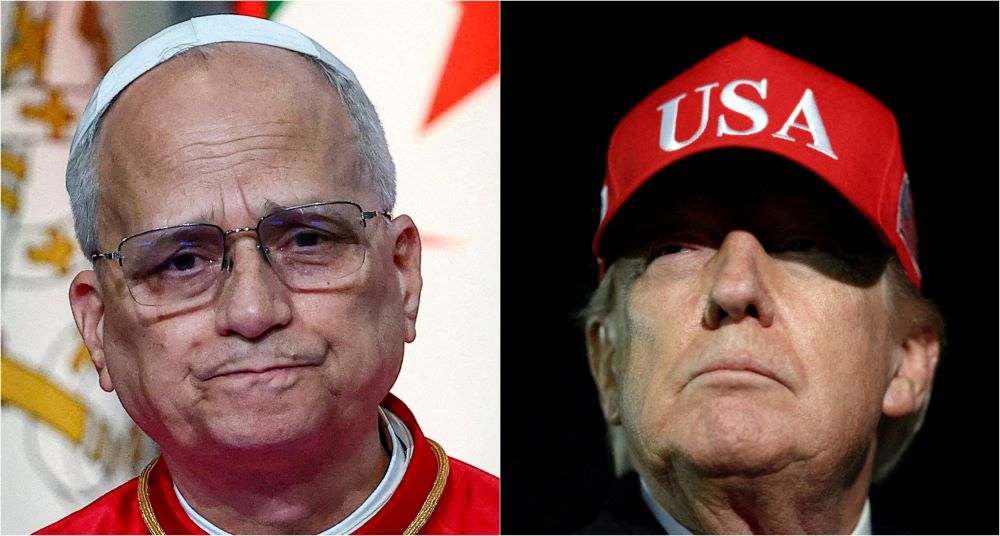
A combination picture shows Pope Leo XIV speaking in at the cultural center of the Great Mosque of Algiers in April 13, 2026, and U.S. President Donald Trump after disembarking Air Force One at Joint Base Andrews in Maryland April 12, 2026. (OSV News/Guglielmo Mangiapane; Reuters/Kevin Lamarque)

Join the Conversation
Send your thoughts to Letters to the Editor. Learn more
Many have been asking if the recent rhetorical kerfuffle between the Holy Father and President Donald Trump and Vice President JD Vance will harm the Republicans' chances in the midterms. It is a more complicated question than it seems.
On the one hand, attacking the pope is clearly a blunder. Why do it? Asking why the president does anything is often a question best posed to a psychologist, not an historian or political scientist. The vice president, who is a convert to Catholicism, only made matters worse, lecturing the pope on his role and the need for precision when he speaks. Surely, Vance could have asked around and realized the foolishness of attacking someone we Catholics consider the vicar of Christ.
On the other hand, voters have short memories and part of Trump's political genius is to flood the media with new stories every day, sometimes every hour, to further decrease the electorate's attention span. The media, used to reporting news and mindful that virtually anything a president says is news, can be forgiven for assisting Trump's distraction agenda by doing their jobs. The prospect of high gas prices, day in and day out, will make it harder for Republicans to retain control of Congress than any bad aftertaste from Trump's foolish rhetorical broadside against Pope Leo and Vance's confused handling of the issues.
The war in Iran has certainly angered millions of voters, especially younger voters whose impressions of Trump are still being formed. Many of these younger voters supported Trump in the 2024 election but are now turning on him because of the war. Whether or not this change is the result of moral calculi is difficult to assess. Last year, when Trump eviscerated foreign aid, including programs that prevent the spread of HIV/AIDS the outrage was subdued, mostly limited to religious and medical groups. Those cuts will likely result in far more deaths than the war in Iran will.
There is one way the attacks on the pope harm the White House's political fortunes, and that is if they continue. Vance is a product of Yale Law School, which is not known for inculcating intellectual humility. His comments on the relationship between religion and politics demonstrated how quickly he is over his head but he did not seem deterred. What is more, Vance, like the man he serves, is surrounded by sycophants who are unlikely to challenge him.
One of the administration's acolytes, Bishop Robert Barron, addressed the relationship of religion to politics in a tweet. Citing paragraph 2309 of the Catechism of the Catholic Church, he wrote: "After laying out the various criteria for determining a just war—proportionality, last resort, declaration by a competent authority, reasonable hope of success, etc.—the catechism points out that 'the evaluation of these conditions for moral legitimacy belongs to the prudential judgment of those who have responsibility for the common good.' "
Barron added, "The role of the Church, therefore, is to call for peace and to urge that any conflict be strictly circumscribed by the moral constraints of the just war criteria. But it is not the role of the Church to evaluate whether a particular war is just or unjust. That appraisal belongs to the civil authorities, who, one presumes, have requisite knowledge of conditions on the ground."
Let us set aside the enormity of that presumption about requisite knowledge, at least as it pertains to the current occupant of the White House. Let us also stipulate that the catechism is on to something, that there is a difference between articulating moral teachings and applying them in the real world. The problem is that Barron turns prudential judgment into a get-out-of-jail-free card, shifting the objective standards of just war theory into a subjective assessment by the president. He also ignores the fact that the U.S. Constitution vests the decision to declare war in the Congress, not the president. The founders wanted many of us contributing to the national understanding of what constitutes the common good, not leaving it to the arbitrary whim of one man.
Barron is not stupid. If he could, convincingly, demonstrate how Trump and Vance have acted prudently, he would have done so. He knows that in the case of this war, the president has utterly failed to articulate prudential answers to any of the questions posed by just war theory. So he leaves the formal category of prudential judgment unmoored from the actual exercise of prudence, turning it from the virtue that it is into a moral vice. Perhaps Barron could roll out a new episcopal motto: MAGA si, magistra, no.
Advertisement
Still, the reason the pope vs. president meme is likely to continue is not the lousy arguments with which acolytes are arming the White House. It is the means. Trump, Vance and Barron are all creatures of social media culture in which the algorithms highlight extremism and drive debates into two camps, profoundly opposed to one another. This way of thinking exacerbates the partisan divide in the country. The two-party system has served our nation well through most of its history, but in the age of social media, the divides have become too large and too atrophied.
The algorithm of the Catholic intellectual tradition is the exact opposite of the social media algorithms. We Catholics lean into both/and approaches to human problems: grace and nature, not grace or nature; the eschatological here and not yet; human and divine; hierarchic and the people of God; justice and mercy. This habit of mind is hard enough for a cradle Catholic to maintain if they go into politics. Harder still in the dystopian age of social media and Trumpism. I wouldn't bet on Vance acquiring the habit and, just so, conflicts with the comments of Pope Leo are likely to continue.
Does this mean the GOP will lose the midterms? Of course not. Catholic Republicans, like Catholic Democrats, have long since learned to check those parts of the Catholic religious and moral worldview that do not conform with their politics at the door to the polling place. If most Catholics were Catholic first, and partisans second, perhaps Trump's and Vance's questioning of the pope would hurt. Then again, if most Catholics were Catholic first, and partisans second, we would not be in this political mess.
You are reading a selection from Michael Sean Winters' weekly newsletter. To get the full edition — including the "In the News" link roundup — delivered 24 hours before it appears online, sign up here!