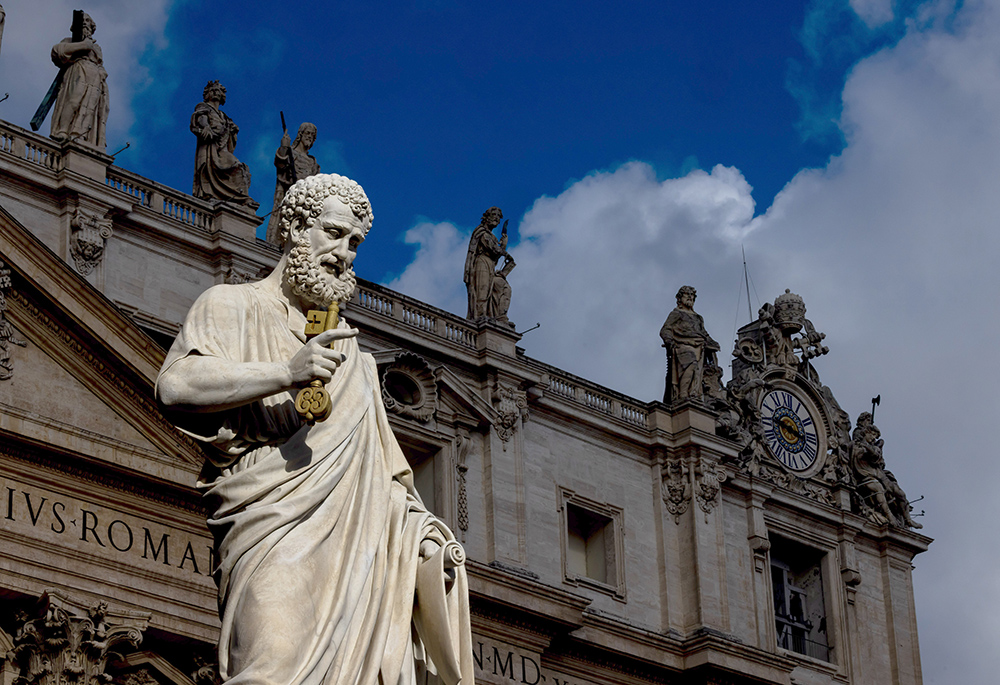
The sun lights up the statue of St. Peter in St. Peter's Square at the Vatican on a stormy Sept. 24, 2025, before Pope Leo XIV leads his weekly general audience. (CNS/Pablo Esparza)

by Mary M. McGlone
Join the Conversation
Send your thoughts to Letters to the Editor. Learn more
"Just who do you think you are?"
How many of us heard that from a teacher, a peer, a parent or someone else who was less than pleased with us at that moment? This rhetorical question springs from an assumption that the questioner and the questioned hold different opinions about the answer.
Have you ever heard the person being questioned respond with, "Well, who do you say that I am?"
We rarely hear someone ask this gutsy, intimate question. It makes both sides vulnerable, a situation we tend to avoid except with people we love and trust deeply. With those people, we discover that those we know best are also great mysteries to us. The more deeply we understand one another the greater our awareness of depths still undiscovered.
When Jesus directed his question to his disciples, Peter spoke for all of them and described Jesus as, "the Christ, the Son of the living God." It was a great answer, except for the fact that it came too quickly and easily. It may have been all that they could say at the moment, but, as we'll see next week, their image of what it meant was different from Jesus' sense of himself and his mission. It was as if Peter were ice-skating on the ocean; he had an idea of what was there, but couldn't perceive its depth. He described Jesus with titles he thought he understood, rather than allowing Jesus to reveal their meaning. Thus, Jesus forbade them from speaking about it.
We hardly ever hear the disciples ask Jesus about his identity, except in John 1:38, when Jesus asked John's disciples, "What are you looking for?" Tongue-tied, they replied, "Where are you staying?" He responded, "Come, and you will see." With those five words, Jesus invited them to really know him, to venture beyond what they thought they knew about the Lamb of God, to drop their preconceptions and allow him to reveal himself to them. Jesus wanted disciples who understood him from his vantage point, not popular expectations.
Paul reminds us that God is a mystery. We have catechism explanations about God as creator and supreme being and scriptural descriptions of God as Father. We have dogma portraying God as the Trinity of everlasting love. The very variety of these descriptions and a myriad of others show how little we really know. When Paul talks about the unfathomable depth and richness of God's mind and purpose, he wants us to be caught up in awe before God, to be stirred to our depths and to realize that the God who grasps us is infinitely beyond our grasp in majesty and humility. (For music that expresses this, listen to Jesuit Fr. John Foley's "Who Has Known.")
Remembering the deep mystery we encounter in every person provides a perspective on today's Gospel. We see Jesus with his closest companions, the ones with whom he traveled, to whom he preached and even entrusted his mission. Perhaps their conversation began with talk about people they'd met, the ones whose hearts leapt with Jesus' message and the ones who were scandalized by him.
Advertisement
Something led Jesus to ask his friends what people were saying about him, things they wouldn't or couldn't say to Jesus directly. They'd all heard enough to offer a variety of responses. Every answer they gave depicted Jesus as a prophet, part of the company of people who spoke for God and were rejected or martyred for what they said. After hearing about the popular perception, Jesus wanted more.
The Jewish philosopher Martin Buber wrote that "[the human being] wishes to be confirmed in his being by man, and wishes to have a presence in the being of the other."
This offers a clue to the deeper question Jesus asked those closest to him. He wasn't seeking titles. Titles are loaded with expectations that may have little to do with the depths of the person who bears them. Jesus was asking each of them who he was to them, a question that simultaneously asked who they were or wanted to be in relation to him. This question took them into the realm of mutual commitment.
This Liturgy of the Word invites us into new depth as Jesus' disciples. It counsels us to exercise great caution in speaking of God because we are so prone to fit God into our frame of reference. These Scriptures invite us to embrace our ignorance as an entryway leading us into being engulfed in God's unsearchable ways. Just as Christ asks, "Who am I to you?" we can ask, "Who do you say that you are and who do you want us to be through, with and in you?"
The response will carry us into a deep and fulfilling mystery, time and again.