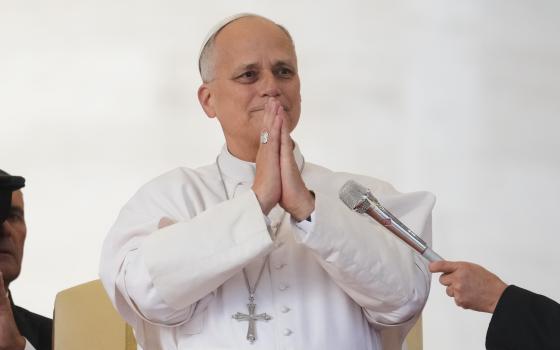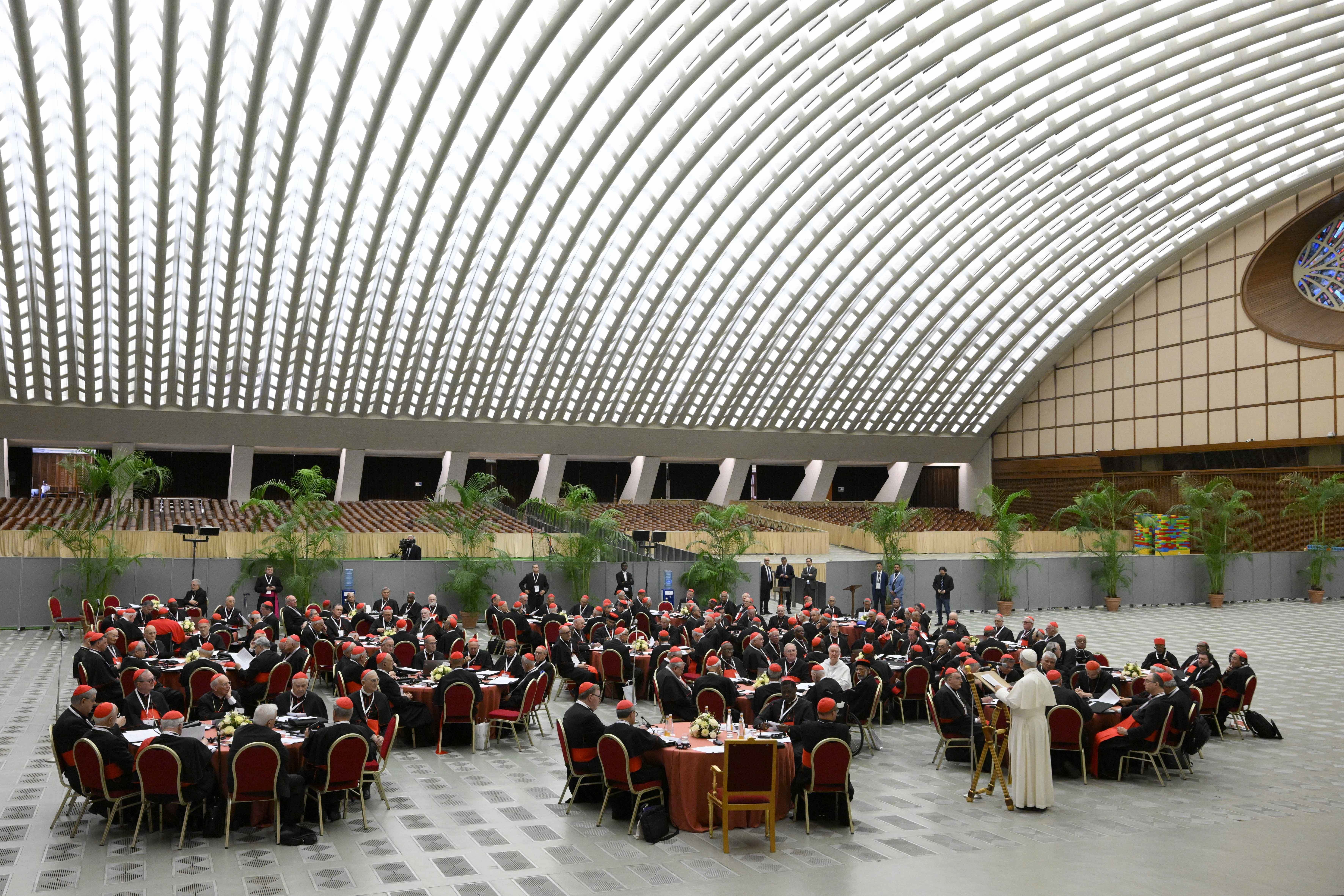
Pope Leo XIV addresses cardinals gathered for the opening working session of his second consistory in the Paul VI Audience Hall at the Vatican June 26, 2026. (CNS/Vatican Media)

Join the Conversation
Send your thoughts to Letters to the Editor. Learn more
Over two days, 178 of the world's cardinals gathered at the Vatican to discuss a sprawling agenda that ranged from the Catholic Church's efforts to become a more listening body to its moral teaching on war.
But for Pope Leo XIV, who has more actively sought to enlist the support of the College of Cardinals in his governance of the church after the college's fraught relationship with his predecessor, the meeting, known as a consistory of cardinals, was itself reason enough to celebrate.
"These days give me renewed hope, not just because of what we’ve shared, but because of the way we’ve done it," the pope said in his closing remarks at the end of the consistory's two days of meetings. "In an era marked by polarization, even the way in which the church listens and engages in dialogue becomes part of its message."
Although the "synodal" style of the meetings has become a sticking point among some conservative church figures — with small-group discussions around roundtables reminiscent of the assemblies held during the church's Synod of Bishops on Synodality — the pope appeared to confidently claim the format as a success.
Leo, who was quickly elected as a unity candidate by a divided College of Cardinals, said the consistory was "not a parliament, not a congress where opinions or interests prevail, but an experience of communion in the service of the mission."
Indeed, he opened the consistory by asking the cardinals not to allow the two days of meetings to be dominated by "particular interests" and to trust in the discussion-based format.
Advancing the church's synodal process
The last of the consistory's four working sessions was dedicated to the church's synodal process — a flashpoint between progressive Catholics who have lauded the Pope Francis-era initiative as a necessary recalibration of the church's rigid hierarchy and conservatives who have viewed it as a threat to the authority of the clergy.
Leo, who participated in the 2024 synodal assembly at the Vatican as a cardinal, signaled his intention to forge ahead on the path of synodality opened by Francis when, in his first speech as pope from the balcony of St. Peter's Basilica, he called for a "synodal church."
To the church's cardinals gathered in the Paul VI Audience Hall, the pope said that "synodality is not a series of meetings, nor a working method, it is a spiritual way."
"It begins with encounter, grows through listening, and matures through discernment," he said.
Introducing the working session, Cardinal Mario Grech, head of the Vatican's synod office, said that "synodality is not an end in itself. It exists so that the church may proclaim the Gospel more effectively and serve the men and women of our times more fruitfully," describing the synod's implementation as "a new stage in the reception of the Second Vatican Council and in the missionary renewal of the church."
In that session, the cardinals expressed the need to "offer to the clergy a vision of the priesthood that is beautiful, creative, and rooted in the Gospel, yet at the same time not clerical," according to a Vatican summary of the meeting.
Advertisement
Rethinking war and peace
Perhaps the most closely watched topic of the consistory was the cardinals' discussion of the sections of Leo's recent encyclical, Magnifica Humanitas, that deal with war.
In one of the previous day's working sessions, the cardinals discussed shifting the language in the church's moral engagement on conflict from one of "just war" to that of "proportional defense," since just war theory has been used to morally justify the launching of wars.
In his closing remarks, Leo recalled that several groups of cardinals "emphasized the need to continue exploring the topic of self-defense in light of the profound changes that have taken place in the nature of contemporary conflicts" and said the issue must "be further developed with the necessary theological and pastoral rigor."
The pope said his encyclical argued that "war is not merely a conflict between states" but rather "originates much earlier, from a culture of power that permeates the way we think, the way we relate to one another, the way we exercise power, and the way we use the economy, technology, and even religion."
In response, the world must "rebuild a culture of cooperation and dialogue, capable of giving new strength to multilateralism," the pope said.
"God desires peace for every nation and every people," Leo said. "That is why we must not resign ourselves to violence. Violence will not have the last word."
Social doctrine in a fractured world
The consistory's other two sessions were dedicated to assessing the state of the world and considering how the church can better contribute to the common good.
In a summary of the meeting's first session, dedicated to the issues of the world today, the Vatican said "numerous groups noted that, while many institutions are facing a crisis of credibility, the church feels called to speak with authority in support of human dignity, peace, reconciliation, and the common good."
Against that backdrop, Leo said he was struck by the cardinals' emphasis on the church's social doctrine.
"You have expressed the desire that it become more and more a living heritage of our communities, a standard for the formation of consciences and for pastoral discernment," he told the cardinals.
Taking up another newsworthy element of Leo's encyclical, the Vatican said that cardinals also noted "how the pope’s stern words in the encyclical regarding the church’s delay in condemning slavery opened the hearts of millions of people to the Gospel."
In Magnifica Humanitas, Leo addressed the church's own history of complicity with the slave trade, stating that Catholics cannot "deny or diminish the delay with which both society and the Church came to denounce the scourge of slavery."
The pope also recalled the cardinals' reflections on the state of young people today, calling the widespread sense of despair among them, which can result in suicide, "one of the deepest wounds of our time."
Yet "their search for authenticity, for genuine relationships, and for meaning reminds us that the Gospel continues to meet the deepest longings of the human heart," Leo said.
Although no date has been set for the next consistory of cardinals, Leo said that he intends to convene the cardinals in Rome for another meeting next year.
He said the synodal spirit that guided the consistory will also shape his October meeting in Rome with the heads of bishops' conferences and Eastern churches.
That meeting will be dedicated to proclaiming the Gospel to families amid a rapidly changing world and reflecting on the legacy of Pope Francis' apostolic exhortation on the family, Amoris Laetitia ("The Joy of Love").
The National Catholic Reporter's Rome Bureau is made possible in part by the generosity of Joan and Bob McGrath.