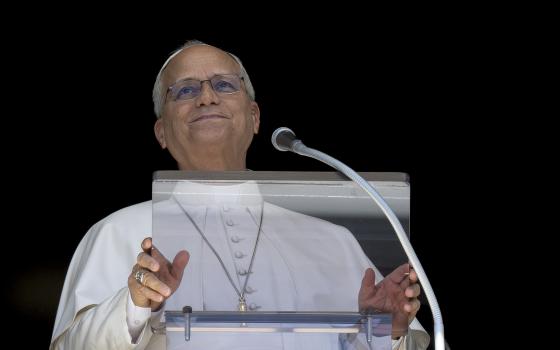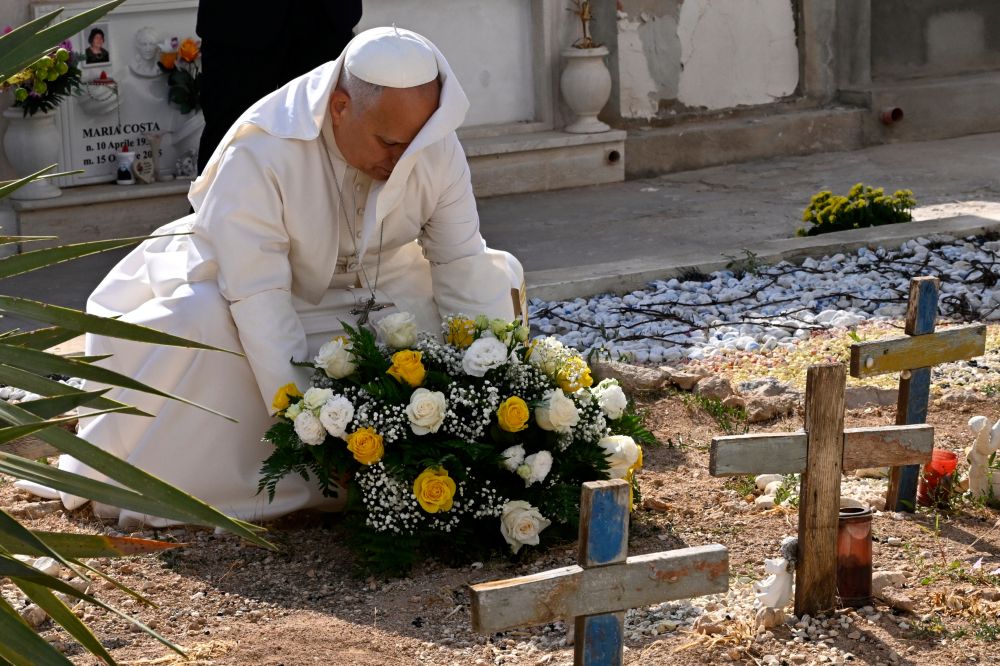
Pope Leo XIV pays tribute at the cemetery and on little Joussef's grave, in Lampedusa, Sicily, southern Italy, Saturday, July 4, 2026, during a one-day pastoral visit to an island that has become a symbol of the risks faced by migrants trying to reach Europe by sea. (Pool photo/Ciro Fusco, via AP)

Join the Conversation
Send your thoughts to Letters to the Editor. Learn more
The Catholic Church's first U.S.-born pope spent the 250th anniversary of his home nation's founding on an Italian island that has become one of Europe's most critical migration flashpoints, presenting care for migrants as a central tenet of the Christian faith and warning that religion must never be used to justify discrimination.
Though the election of Pope Leo XIV, born and raised in a Chicago suburb, prompted speculation that the first U.S. pope might visit the United States during the nation's semiquincentennial year, Leo instead traveled July 4 to Lampedusa, the tiny island south of Sicily that has become a major destination for migrants crossing the Mediterranean from North Africa.
According to the Italian Red Cross, nearly 100,000 migrants reached the island over a 10-month period from 2023- 2024; the Italian Coast Guard said 17 migrants arrived by boat the night before Leo’s visit.
Celebrating Mass there, Leo said that "it is time to recognize and affirm that religious affiliation must never become a reason for discrimination, as if faith had boundaries rather than being a universal call to salvation."
Though the pope did not direct his message at any particular country or political leader, his remarks offered a sharp contrast with recent religious rhetoric used by the highest-ranking Catholic in the U.S. government, Vice President JD Vance, who said days earlier that his Catholic faith informed his opposition to foreigners entering the United States.
In a July 1 Fox News interview with Laura Ingraham, another Catholic convert, Vance said his Catholic faith reminded him that the nation's economic policies exist "to support the dignity of human beings."
"That's why we don't like low-wage foreigners coming in and undercutting the wages of American workers," Vance continued. "We want normal Americans to be able to live a dignified life and I think that's a very, very Christian concept."
The statement continued the vice president's pattern of invoking religious arguments to defend a more restrictive approach to immigration. In February 2025, Vance invoked an obscure Catholic theological principle to state that people must care first for their own families and fellow citizens before attending to the needs of foreigners, an argument that prompted a pointed rebuke from Pope Francis.
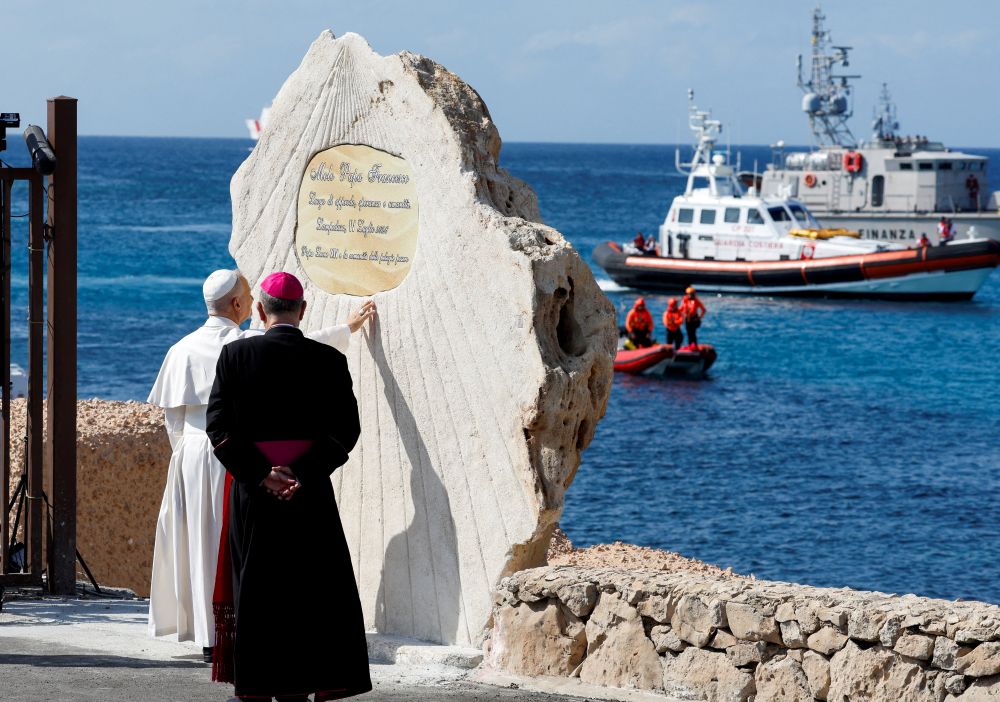
Pope Leo XIV blesses a plaque at Molo Favaloro in Lampedusa, Italy, and dedicates the pier to Pope Francis as he visits the island, a key entry point for migrants crossing the Mediterranean Sea, during a pastoral trip July 4, 2026. (OSV News/Reuters/Remo Casilli)
With his visit to Lampedusa, Leo also symbolically took up the mantle of his predecessor, who placed migration at the center of his pontificate by visiting the island in July 2013, just four months after his election and in his first trip outside Rome.
It took Leo 14 months after his own election to get to Lampedusa, but he has repeatedly spoken forcefully about the Christian obligation to care for migrants. At the height of nationwide raids by Immigration and Customs Enforcement in the United States, Leo said the treatment of migrants there was "inhuman." Last month, during a visit to Spain's Canary Islands, he said the church "cannot be silent" about migrants who perish in the Atlantic Ocean while trying to reach Europe from Africa.
After arriving in Lampedusa, Leo visited a cemetery where migrants, including children, who died attempting to reach the island are buried. Kneeling before one of the graves, he placed a wreath of flowers on a tomb.
He then greeted several migrants amid fierce winds that at one point blew the pope’s white skullcap from his head before visiting the "Door of Europe," a 16-foot monument on the island’s southernmost point dedicated to those who have died crossing the Mediterranean.
Addressing local civil and church officials, Leo said he had "not come to make speeches, but to celebrate the Eucharist: the supreme sign of Jesus Christ among us."
"This is a place where gestures speak more than words," he said.
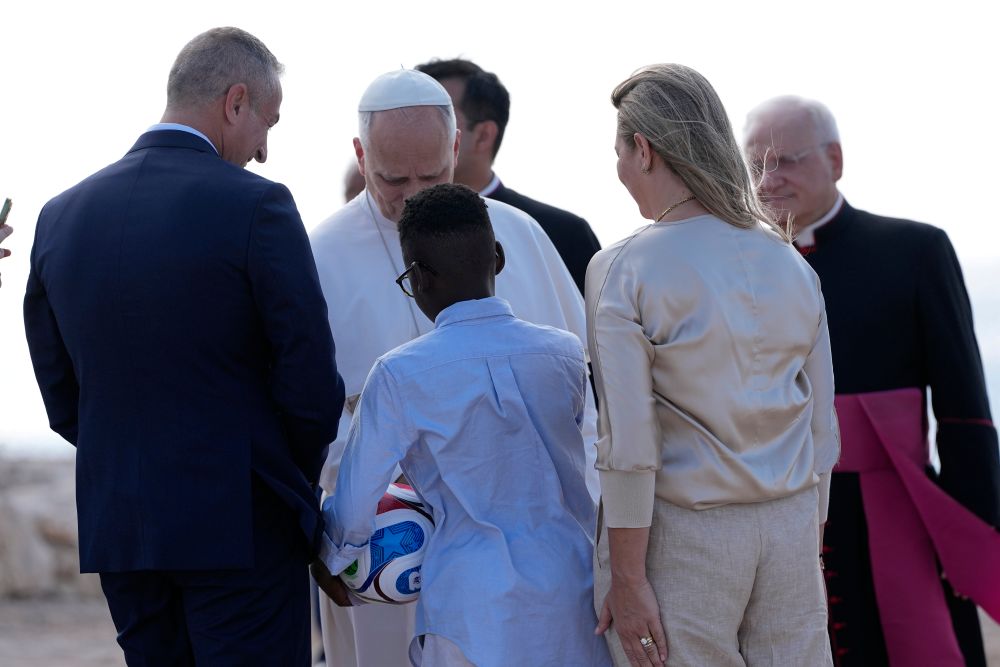
Pope Leo XIV meets Leo, a boy migrant, as he visits the Gateway of Europe monument in Lampedusa, Sicily, southern Italy, Saturday, July 4, 2026, during a one-day pastoral visit to the island long associated with the plight of migrants crossing the Mediterranean. (AP/Alessandra Tarantino)
At Mass, Leo said that "before any intellectual consideration or ideological conviction, the encounter with those who lie before us, stripped of everything, calls us to be close to them."
"Those who have lost their lives in this sea are victims both of decisions that were made and of decisions that were not made," the pope said, citing "indifference to the common good and corruption in their countries of origin; a global economic system that generates poverty and exclusion; fear that fuels prejudice and contempt; the belief that such problems do not concern us; the criminal calculations of those who profit from the suffering of others; the slow and difficult transition from mere emergency management to the development of comprehensive and shared policies."
Leo called on Europe to develop "a long-term strategic plan capable of receiving, protecting, supporting and integrating migrants, while at the same time assisting developing countries so that no one is forced to emigrate."
But on the 250th anniversary of the founding of the United States, the pope also had words for his home country.
In a letter addressed to the American people and published by the Vatican July 4, unrelated to his visit to Lampedusa, Leo wrote that "defending human life also includes welcoming, protecting and assisting immigrants, whose hopes, sacrifices and contribution have formed part of the history of this country from its very beginning."
"In every generation, those who have arrived seeking freedom, opportunity and a place to belong have helped to shape the nation’s character," he wrote. "To receive them with compassion and generosity is not only an act of charity, but also a recognition of the dignity that belongs to every human person."
The previous day, Leo addressed the American people by livestream during a ceremony honoring him with the Liberty Medal from the National Constitution Center in Philadelphia. In those remarks, he again underscored the role of generations of migrants and their children who came to the United States "to play their part in shaping the future of the nation."
Although speculation continues to mount over when Leo might visit the United States, the Vatican has said that there will be no homecoming for the U.S.-born pope this year.
The National Catholic Reporter's Rome Bureau is made possible in part by the generosity of Joan and Bob McGrath.
Advertisement