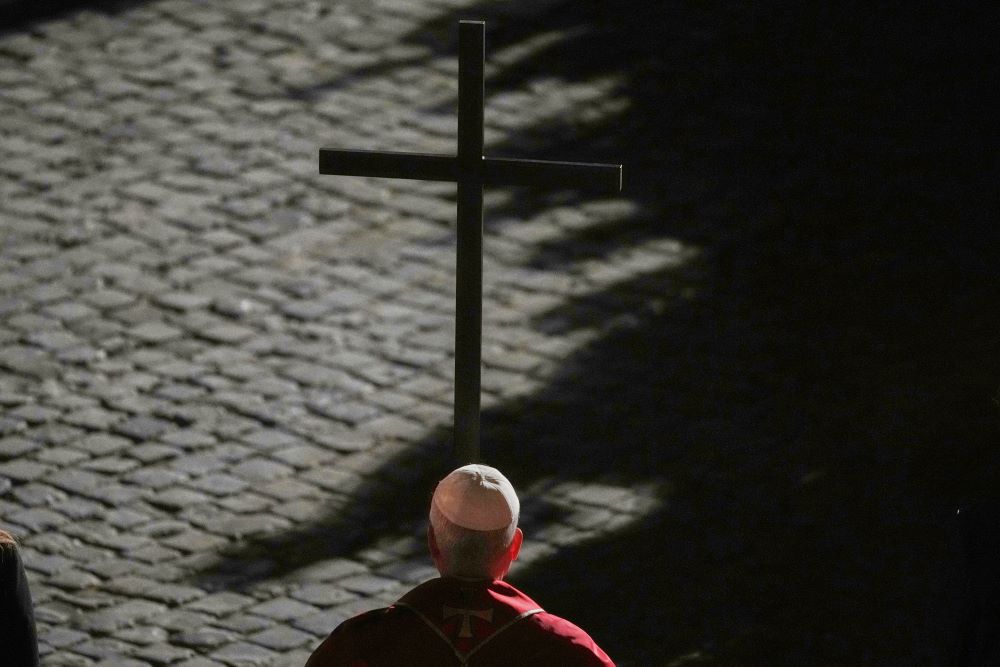
Pope Leo XIV carries a lightweight, 5-foot wooden cross during the Via Crucis, the torchlit Good Friday Stations of the Cross procession at the Colosseum in Rome April 3. The Stations of the Cross symbolically retrace Jesus Christ's steps to his crucifixion on Calvary in Jerusalem. (AP/Alessandra Tarantino)

Join the Conversation
Send your thoughts to Letters to the Editor. Learn more
In the shadow of a world scarred by conflicts, Pope Leo XIV chose to carry the cross himself for the Vatican's traditional Way of the Cross service, praying that God would raise up those oppressed by war, economic exploitation and personal crisis.
"Every person in authority will have to answer to God for the way they exercise their power," including the "the power to start or end a war," said the meditations read aloud for Leo's first Way of the Cross as pope.
At the visually striking ceremony on Good Friday in which some 30,000 people encircled Rome's Colosseum with lit candles in hand, the meditations read aloud during the Way of the Cross procession touched on wide-ranging circumstances of suffering, returning repeatedly to the plight of war but not limited exclusively to it.
The meditations were prepared by the former superior of the Franciscan order in the Middle East, Franciscan Fr. Francesco Patton.
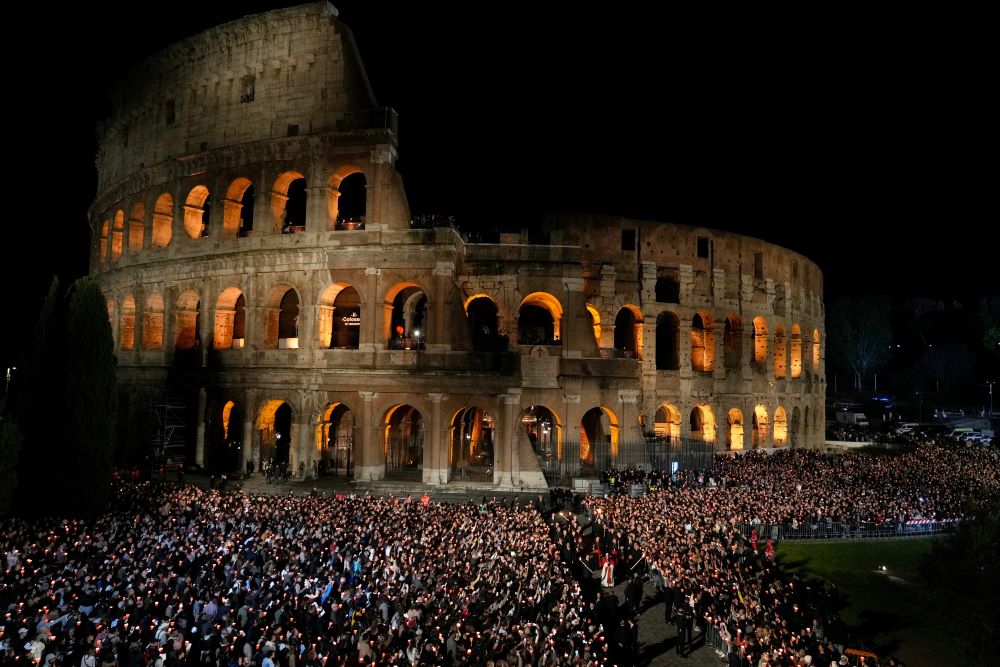
About 30,000 people encircled Rome's Colosseum with lit candles in hand as Pope Leo XIV led the Way of the Cross procession on Good Friday, April 3. (AP/Gregorio Borgia)
Reflecting on the suffering of women worldwide at the eighth station — when Jesus meets the women of Jerusalem — the meditations noted the challenges of women "tending to the wounded and comforting survivors in war zones and areas of conflict," as well as those weeping for children "killed in war zones, and wiped out in death camps."
When Jesus is stripped of his garments in the 10th station, the service reflected on "when authoritarian regimes force prisoners to remain half-naked in bare cells or courtyards" and "when rapists and abusers reduce their victims to mere objects; when the entertainment industry exploits nudity for the sake of profit."
The meditations also included reflections on those with "the power to use the economy to oppress people or to liberate them from misery" and prayed that Jesus would raise up "those who are crushed to the ground by injustice, by falsehood, by every form of exploitation and violence, and by the misery produced by an economy that seeks individual profit rather than the common good."
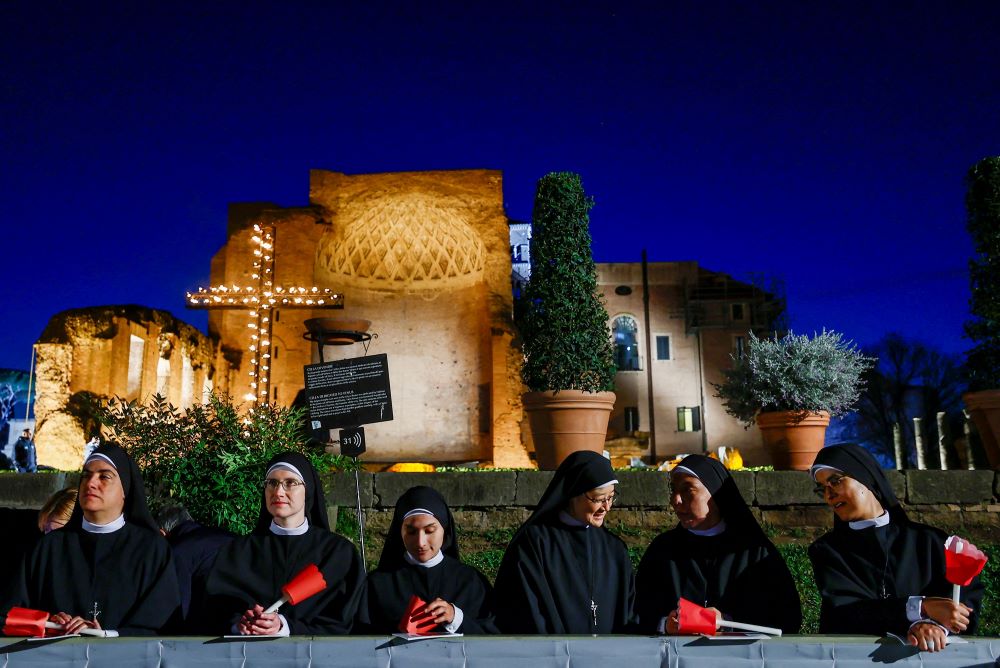
Nuns gather outside the Colosseum ahead of the Way of the Cross procession presided over by Pope Leo XIV during Good Friday celebrations in Rome April 3. (OSV News/Reuters/Vincenzo Livieri)
Flanked by two laypeople bearing burning torches, the pope moved in procession through the interior of the Colosseum for the opening stations before emerging into the night and ascending a staircase, cross in hand, to the ancient Temple of Venus and Rome, where he paused beneath a towering cross lit with candles.
Previous popes had entrusted the task of writing the meditations to prominent clergy, groups of laypeople or members of marginalized groups; Leo's choice of a Franciscan friar this year gave the stations a distinctly Franciscan flavor, pairing each Gospel reading with texts from St. Francis of Assisi, whose death marks its 800th anniversary in 2026.
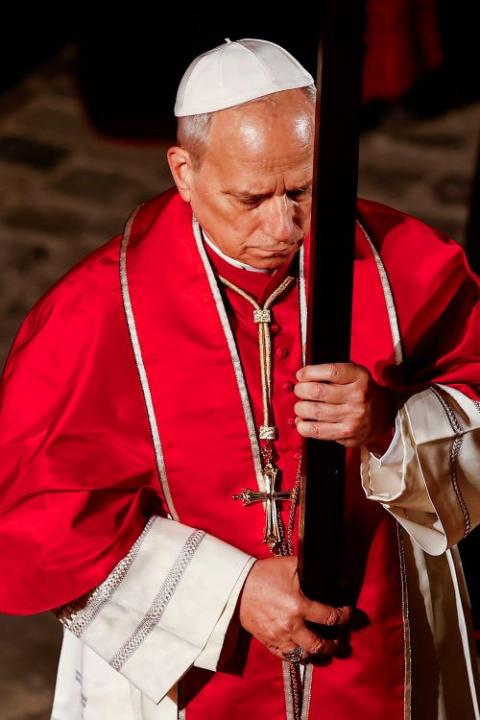
Pope Leo XIV leads the Way of the Cross at the Colosseum in Rome April 3, 2026. (OSV News photo/Reuters/Vincenzo Livieri)
In his first Way of the Cross as pope, Leo chose to carry the cross around the 14 stations, an uncommon but not unprecedented move.
He had told reporters earlier in the week that the decision to carry the cross himself was an "important sign because of what the pope, a spiritual leader, represents in the world today, as a voice that all people want to hear."
In a Holy Week in which the pope has ramped up his anti-war rhetoric — even calling on President Donald Trump by name to seek an "off-ramp" in the United States and Israel's war on Iran — the choice for a prelate with a strong connection to the Middle East to write the meditations underscored Leo's desire to send a strong message of peace for the region.
The prayer intentions offered at each station were varied, including prayers for victims of trafficking, migrants and refugees. They included prayers calling for people to weep in the face of massacres and genocides and to have compassion for incarcerated persons, political prisoners and the families of hostages.
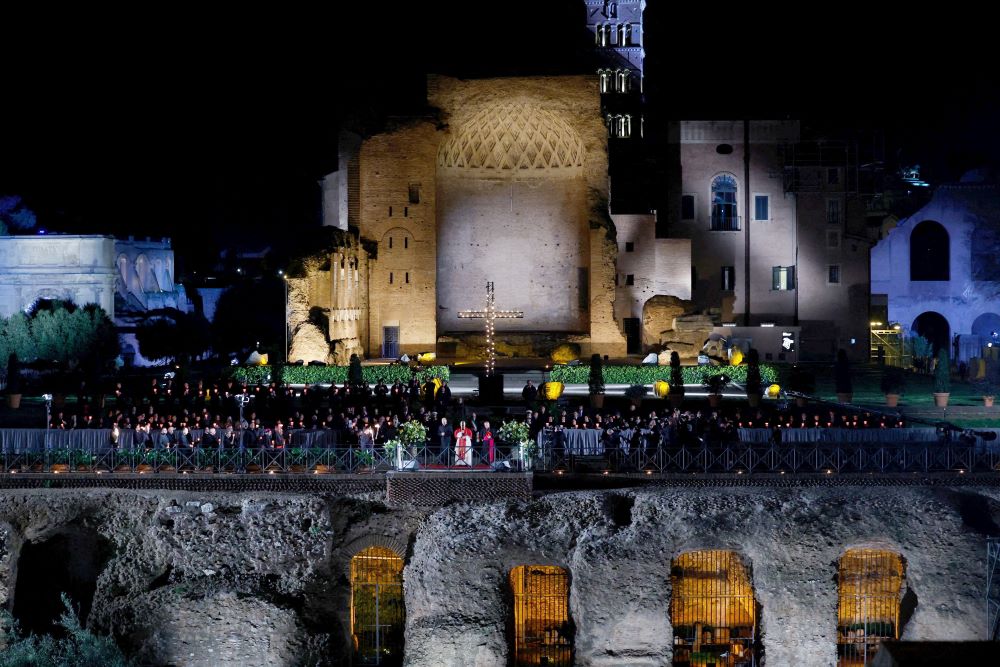
Pope Leo XIV leads the Way of the Cross at the Colosseum in Rome April 3, 2026. (OSV News/Reuters/Remo Casilli)
Though no single theme stuck out as prevalent among the meditations, each of them spent ample time reflecting on the figure of Jesus whose self-sacrifice flies in the face of worldly power.
Jesus does not "resort to the supposed power of armies, but to the apparent powerlessness of love, which allows itself to be nailed to the cross," the text said.
In keeping with the Franciscan theme of the evening, Leo closed the service with a prayer of St. Francis: "May we be able to follow in the footprints of your beloved Son, our Lord Jesus Christ."
He then offered the crowds a blessing that was typical of the Italian saint and used to bless his fellow friars, asking that God "turn his countenance toward you and give you his peace."
Advertisement
The National Catholic Reporter's Rome Bureau is made possible in part by the generosity of Joan and Bob McGrath.