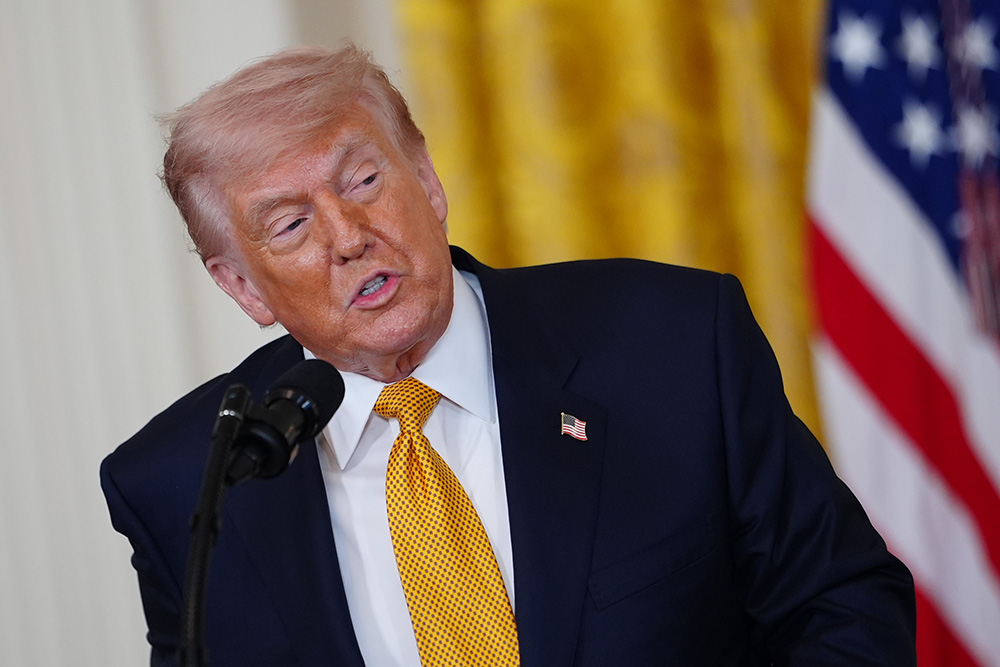
President Donald Trump speaks during an event for military mothers in the East Room of the White House May 6, 2026, in Washington. (AP/Julia Demaree Nikhinson)

Join the Conversation
Send your thoughts to Letters to the Editor. Learn more
A majority of U.S. adults across demographics have expressed wide disapproval of President Donald Trump's recent war of words with Pope Leo XIV, as well as an image seemingly depicting Trump as Jesus, a new poll found.
The Washington Post-ABC News-Ipsos survey found 57% of U.S. adults held a negative view of Trump's comments on social media April 12 where he said: "I don't want a Pope who thinks it's OK for Iran to have a Nuclear Weapon."
Among Catholics, 61% had a negative reaction to the president's words; 39% held a strongly negative view, eclipsing the 36% of U.S. Catholics who viewed it somewhat or strongly positive.
One of the strongest negative reactions came from Hispanic Catholics (71%), part of a key demographic that shifted Republican in the 2024 election and helped return Trump to the White House.
Survey respondents uniformly rebuked an image Trump posted that appeared to portray himself as Jesus. More than eight-in-10 U.S. adults viewed it negatively, with 69% viewing it strongly negatively. Across all demographics, the lowest negative response was among self-identified MAGA Republicans at 73%. The president, who eventually deleted the image, later said it was meant to show him as a doctor.
In contrast, U.S. adults have a largely positive view of Leo, the first U.S.-born pope who on May 8 marks one year since his election: Forty-one percent view him favorably compared to 16% who view him unfavorably. A plurality (43%) had no opinion or skipped the question.
Sixty-one percent of U.S. Catholics view Leo favorably, the poll found, as did 60% of white Catholics and 59% of Hispanic Catholics. Among all religious services attendees, 41% of those who go weekly view Leo favorably along with 48% of those who attend less often.
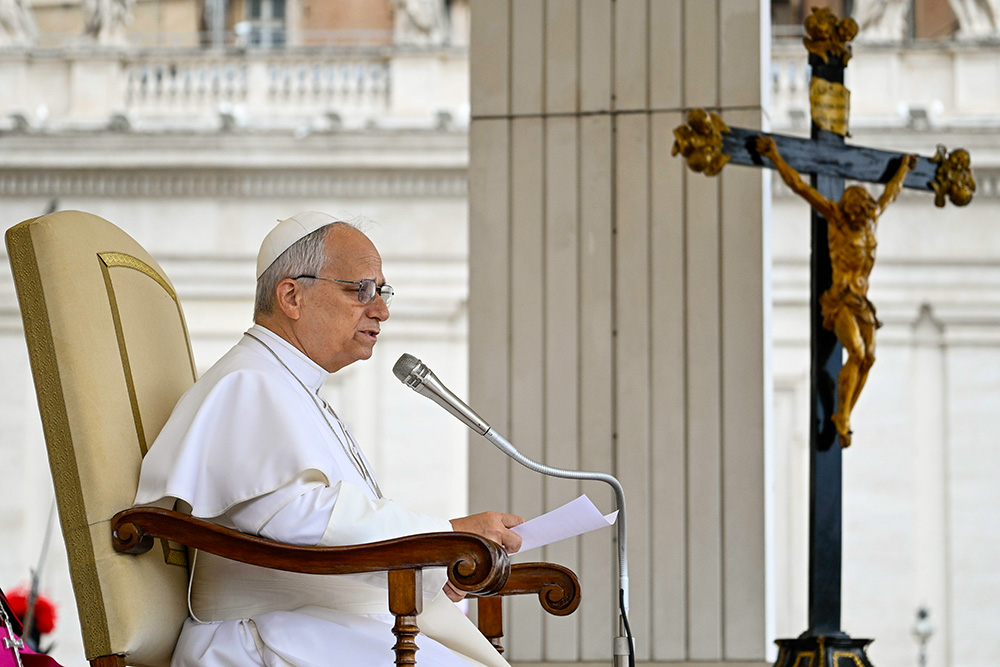
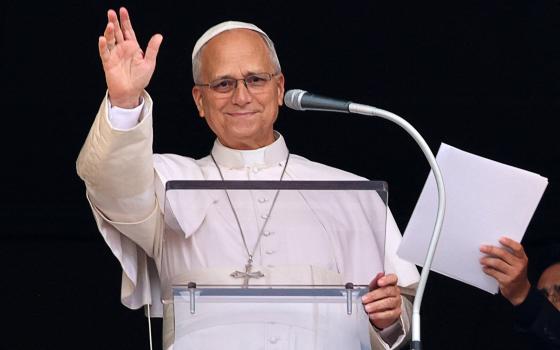
Pope Leo XIV delivers his remarks during his weekly general audience in St. Peter's Square at the Vatican May 6, 2026. (CNS/Vatican Media)
The findings present evidence of widespread discomfort with Trump's religious rhetoric and use of religious symbols that have magnified during the U.S. war with Iran, said David Buckley, the Paul Weber Endowed Chair of Politics, Science and Religion at the University of Louisville. In July, he will take over as director of the Boisi Center for Religion and American Public Life at Boston College.
"It's discontent that cuts across some of the major religious and partisan gaps that we frequently think of as so powerful in U.S. politics," Buckley said.
The survey was conducted April 24-28 and spoke with 2,560 U.S. adults. Its margin of error is plus or minus 2 percentage points. Questions on Trump's Jesus-like image and another post in which he threatened to wipe out Iran's civilization were part of a smaller segment of 1,268 U.S. adults, with an error margin of plus or minus 2.8 percentage points.
The overwhelming majorities of Americans, even Trump supporters, responding negatively to the Jesus-like image of Trump was striking, said Kim Daniels, director of the Initiative on Catholic Social Thought and Public Life at Georgetown University.
"It's rare to find that kind of unified response on anything these days, and it signals that something deeper than politics is going on. Pope Leo is a face of that 'something deeper,' " she said in an email.
Leo's strong favorability among Americans, including his calls for peace, "shows that there's a hunger for moral leadership that transcends partisan politics," Daniels said.
"Pope Leo's moral authority comes from something deeper, and Americans are responding to it."
Trump has continued his criticisms of Leo in the weeks after his initial social media post. In an interview Monday, he again falsely claimed that Leo supports Iran acquiring a nuclear weapon. The pope, in line with his predecessors, has repeatedly spoken against the use of nuclear arms by any nation and has called for disarmament and dialogue, a contrast with the Trump administration's philosophy of peace through force.
Responding to Trump's latest comments, Leo restated the church's longheld position against nuclear weapons.
"The mission of the church is to preach the Gospel, to preach peace. If someone wants to criticize me for announcing the Gospel, let him do it with the truth," the pope told reporters on May 5 at the papal residence in Castel Gandolfo, outside Rome.
Two-thirds of U.S. adults and 70% of Catholics in the survey viewed positively Leo's past call for Americans to contact members of Congress asking they reject war and work for peace, while 30% of U.S. adults saw it negatively (27% Catholics).
More than half of respondents also had strong negative reactions to another Trump social media post April 8 in which he threatened, "A whole civilization will die tonight, never to be brought back" if Iran did not reach an agreement with the United States. Overall, 76% viewed the post negatively, compared to 21% positively. Catholics responded similarly (75% vs. 22%).
Americans also widely rejected (69%) the religious-tinged language used by Defense Secretary Pete Hegseth, who during a March prayer service at the Pentagon prayed to God for "overwhelming violence of action against those who deserve no mercy."
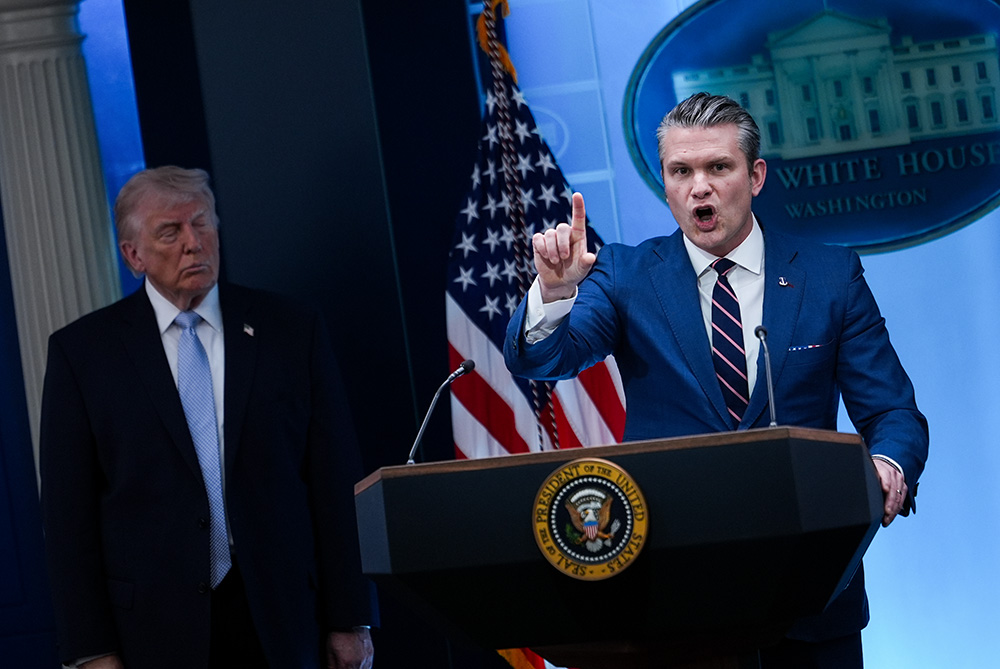
President Donald Trump watches as Defense Secretary Pete Hegseth speaks with reporters in the James Brady Press Briefing Room at the White House April 6, 2026, in Washington. (AP/Julia Demaree Nikhinson)
Nearly seven-in-10 U.S. Catholics responded negatively to Hegseth's prayer, as did more than 60% of Protestants and other Christians. Only among Republicans, and specifically Trump's MAGA base and those who voted for him in 2024, was there a majority that viewed the remarks positively.
The poll shows "the volume of distaste for this type of politics," said Michael Murphy, director of the Hank Center for the Catholic Intellectual Heritage at Loyola University Chicago. "It's the worst kind of politics. It's not the better kind that Pope Francis wrote about in [his 2020 encyclical] Fratelli Tutti."
Partisan divisions were evident in the survey questions regarding the pope.
Among Democrats, 68% viewed Leo positively versus 5% negatively; the split was 23% positive, 30% negative with Republicans. For independents, 37% viewed Leo positively and 12% viewed him negatively.
A vast majority of GOP respondents (76%) reacted positively to Trump's criticism of the pope on Iran, compared to 85% of Democrats who saw it negatively, as did 64% of independents.
Where nine-in-10 Democrats responded positively to Leo's calls for Americans to press elected officials to reject war and work for peace, 57% of Republicans saw it negatively.
The survey also revealed some notable shifts among Republicans and other parts of Trump's supporters on his administration's recent religious comments.
While three-in-four GOPers viewed the president's criticisms of the pope on Iran and nuclear weapons positively, as did 85% of his MAGA base, a far smaller majority of non-MAGA Republicans (56%) shared the view, while 41% of that segment viewed the post negatively.
Advertisement
A similar division in Republican support was evident in response to Hegseth's prayer for violence, where 65% of MAGA Republicans saw it as positive while 67% of non-MAGA Republicans viewed it negatively. MAGA Republicans were twice as likely (38%) to hold unfavorable views of the pope than non-MAGA Republicans (16%).
One point of unison came in response to the Jesus-like image of himself Trump posted, which drew near-universal condemnation across politics, religion, race and region. Roughly eight-in-10 Republicans viewed it negatively, as did 2024 Trump voters, along with 73% of MAGA Republicans and 94% of non-MAGA Republicans. Nine-in-10 Catholics and Protestants viewed it negatively, which also held steady for white evangelical Protestants and white Catholics.
"This could be seen as evidence that religion is contributing to divisions among Republicans that could prove important in future election cycles," Buckley said.
How much Trump's religious rhetoric impacts the midterm elections remains unclear.
Despite disapproval ratings at their highest point across his two terms, the president carried high approval ratings with Republicans (85%) in the Washington Post-ABC New-Ipsos poll. Democrats (95%) and independents (73%) largely disapproved.
Among U.S. Catholics, 38% approved of Trump's presidential record, a 10-point drop from February 2025. A total of 61% of Catholics disapproved, as did majorities of Hispanic (72%) and white (51%) Catholics. In 2024, an estimated 53% of Catholics voted for Trump.
While the survey presents the latest set of warning signs for the president and Republicans heading into November, Buckley cautioned against making electoral predictions, saying overall the poll's questions around Trump and religion show "partisanship is still a very, very powerful force."
"We shouldn't assume that necessarily all religious Americans will actually automatically abandon the president on these issues," he said.