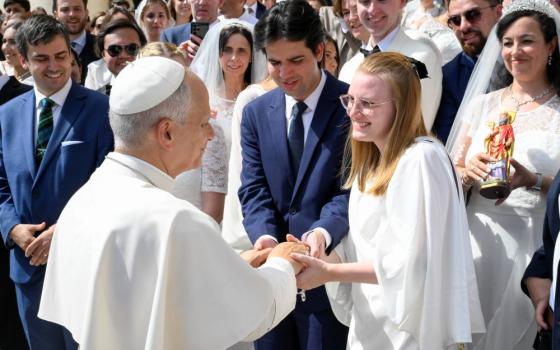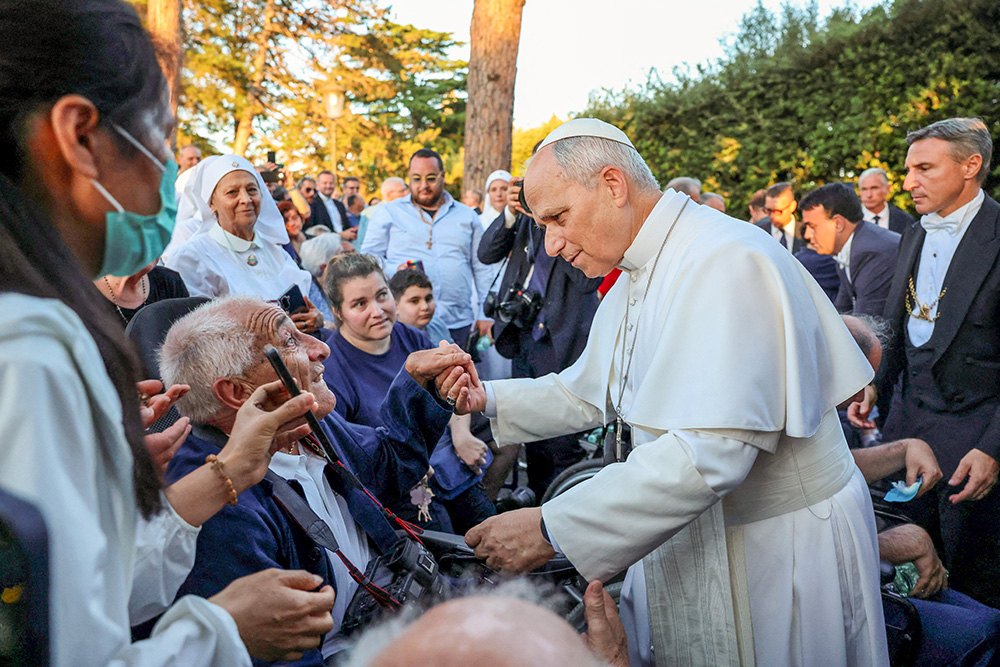
Pope Leo XIV greets the faithful after leading a worldwide rosary for peace at the Grotto of Our Lady of Lourdes in the Vatican Gardens May 30, 2026. (OSV News/Reuters/Yara Nardi)
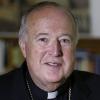
by Robert McElroy
Join the Conversation
Send your thoughts to Letters to the Editor. Learn more
Editor's note: Below is a transcript of a talk delivered via video by Cardinal Robert McElroy to a meeting of Pax Christi International in Rome, which took place Sept. 9-10. It has been edited for clarity.
During the past six months, we have witnessed a remarkable transformation in Catholic teaching on war and peace. In Magnifica Humanitas and in the presentations to and conversations within the June consistory of cardinals, tremendous progress has been made toward eclipsing the role of the just war tradition in Catholic teaching, and moving peace-building, multilateralism and active nonviolence toward the center of Catholic thought.
Ever since Pacem in Terris was written in 1963, every successive pope has pointed increasingly to the moral depravity of war. Pope John XXIII proclaimed, "It is hardly possible to imagine that in an atomic era, war could be used as an instrument of justice." Pope Paul VI journeyed to the United Nations to plead with the world, "No more war. War never again." Pope John Paul II taught that war is never an appropriate way to settle disputes among peoples — "it has never been and it will never be." Joseph Ratzinger chose the name Benedict to tie his entire pontificate to that of Pope Benedict XV, who had tried to end all war.
But it was Pope Francis who utilized the trajectory of all of these statements to construct a framework for Catholic teaching on war and peace that placed peace-building and nonviolence rather than the just war ethic as the primary prism through which to evaluate decisions in situations of deep conflict. In Fratelli Tutti, he wrote: "We can no longer think of war as a solution, because its risks will probably always be greater than its supposed benefits. In view of this, it is very difficult nowadays to invoke the rational criteria elaborated in earlier centuries to speak of the possibility of a 'just war.' Never again war!"
Francis was even clearer in his elaboration on the horrific nature of war as it has emerged in our times:
Every war leaves our world worse than it was before. War is a failure of politics and of humanity, a shameful capitulation, a stinging defeat before the forces of evil. Let us not remain mired in theoretical discussions, but touch the wounded flesh of the victims. Let us look once more at all those civilians whose killing was considered "collateral damage." Let us ask the victims themselves. Let us think of the refugees and displaced, those who suffered the effects of atomic radiation or chemical attacks, the mothers who lost their children, and the boys and girls maimed or deprived of their childhood. ... In this way, we will be able to grasp the abyss of evil at the heart of war. Nor will it trouble us to be deemed naive for choosing peace.
The charge of naivete traditionally leveled against advocates of nonviolence has been gravely diminished in its legitimacy in recent years through a series of studies of real-world conflicts. Erica Chenoweth and Maria Stephan's book titled Why Civil Resistance Works used quantitative data from a wide variety of conflicts within and among nations. Some ended in armed conflict, others did not. But their demonstration that nonviolent resistance can often be significantly more effective than armed defense in achieving the sustainable vindication of human rights in the forms of conflict that have emerged as the dominant military confrontations of our day lends tremendous strength to the proposition that the church should place peace-building and nonviolent resistance at the center of its theology of war and peace.
Advertisement
Pope Leo XIV has repeatedly taken up this emphasis on nonviolence in his pontificate. "From local and everyday situations up to the international order, whenever those who have suffered injustice and violence resist the temptation to seek revenge, they become the most credible agents of nonviolent peace-building processes. Nonviolence, as a method and a style, must distinguish our decisions, our relationships and our actions."
In Magnifica Humanitas, the Holy Father surveys the continuing recourse to war and recalls that St. Paul VI stated that competition among superpowers and within the world should be supplanted by a civilization of love in which justice and charity might replace competition and conflict within the international system. Leo notes that the Cold War ethos of Paul VI is no more, but the international system is, if anything, in a more dire state.
"In our times," he says, "a culture of power is taking hold in which the availability of resources and the ability to dominate tend to dictate the agenda and criteria for decision-making."
War is being normalized, Leo writes. We have entered into a violent culture "where peace no longer appears as a responsibility to be taken on, but as a fragile interval between conflicts."
Nuclear arsenals are being enhanced. The trade in conventional arms provides countries with the access to start new wars more easily even as it impoverishes the citizens whose lives they are ostensibly meant to protect.
Amid a culture that rejects multilateralism, increasingly paints rivals as irreconcilable enemies, seeks unconditional surrender in wars, and regards war as an inevitable part of human existence, Leo understands that it is tempting to think we can do nothing to effectively change these realities.
In response to this feeling of hopelessness, the Holy Father says, quoting J.R.R. Tolkien, "It is not our part to master all the tides of the world, but to do what is in us for the succor of those years wherein we are set, uprooting the evil in the fields that we know, so that those who live after will have clean earth to till."
Leo states clearly this is the call of every Christian and all people of goodwill to build up a civilization of love: disarming our own words and actions, building peace through justice, institutionalizing collaboration, adopting the perspective of victims, cultivating a healthy realism, and reviving dialogue and bonds of amity among peoples and nations. Leo's demarcation of the civilization of love is moving active nonviolence more toward the center stage of Catholic teaching on war and peace.
This movement is greatly reinforced by the recent statements of the pope on the status of the just war theory. This just war framework, which is rooted in the insights of St. Augustine, proceeds from the conviction that at times a stance of nonviolence does not produce either true justice or true peace.
At many times in the church's history, this ethic of just war has been viewed as the primary Christian teaching on war and peace. But it is essential to understand that even when this was true, the church consistently accepted the just war framework only as an explicit constraint on the recourse to war, not as a pathway that made war easier.
Just war thinking consists of two sets of moral prerequisites for engaging in warfare. The first, called the ius ad bellum, consists of the requirements for morally going to war. These include a just and grave cause such as the defense against a major attack by another nation; the exhaustion of all efforts to avoid war; the consent of the national sovereign; the right intention; a reasonable chance of success; and the conviction that the harm caused by war will not outweigh the good that will be achieved.
The second set of moral prerequisites in the just war tradition is called the ius in bello and consists of never directly attacking civilian populations and guaranteeing that every major action in war should yield a good that outweighs the harm it will bring.
Throughout much of history, the just war criteria did at times block the recourse to war and limit its destructiveness. But many elements of modern warfare have conspired to limit its power as a constraint on war, which was the tradition's only reason for existence.
One problem lies in the reality that for so many recent uses of the tradition to evaluate a decision for military action, the just war framework has been distorted to become a source of justification for those inclined to go to war, rather than a constraint on war. One of the accelerants for this trend is the unfortunate statement in the Catechism of the Catholic Church that the evaluation of the just war criteria belongs to those who have responsibility for the common good. It is objective moral reality that determines whether the ius ad bellum has been met, not the views of political leaders.
Another problem is that distinguishing between military and civilian targets in bombing campaigns has become enormously more difficult in our era of massive bombing, allowing aggressors to claim falsely that the deaths of civilians were only collateral damage in necessary attacks. The bombing of Gaza is a tragic example of this moral failure.
In addition, the just war framework is defective in two crucial areas of moral choice. The first is the requirement of right intention, which demands that a nation seek peace consistently, even if it means making significant concessions. The United States does not even have a coherent intention for the Iran war, but rather an oscillating one that seems to change every day. Secondly, the just war tradition does not include a realistic set of moral criteria for seeking war termination, which is so vital for decision-making in the war in Iran.
Leo declared categorically in Magnifica that just war thinking can no longer constitute an authentic pathway for moral guidance in the life of the church. During the consistory of cardinals in June, Cardinal Victor Fernández, the prefect of the Dicastery for the Doctrine of the Faith, presented a framework that enormously limits moral recourse to war, using the notion of proportionate defense. It will guard effectively against the expanding misuse of just war thinking that we have witnessed in our day.
The standards of proportionate defense will be refined during the coming months and will constitute an enormous step in reconciling the profound rejection of war by all the popes of the nuclear era with the specific requirements for the use of force enunciated by the church.