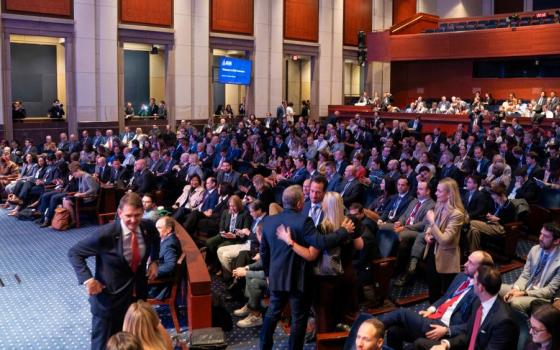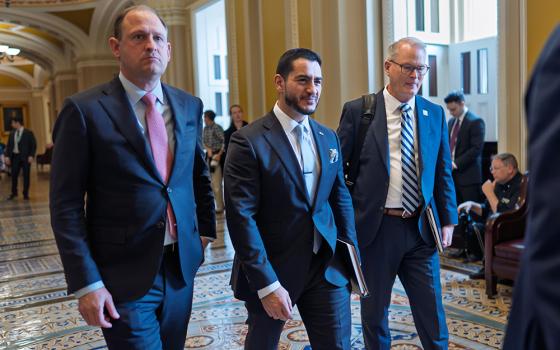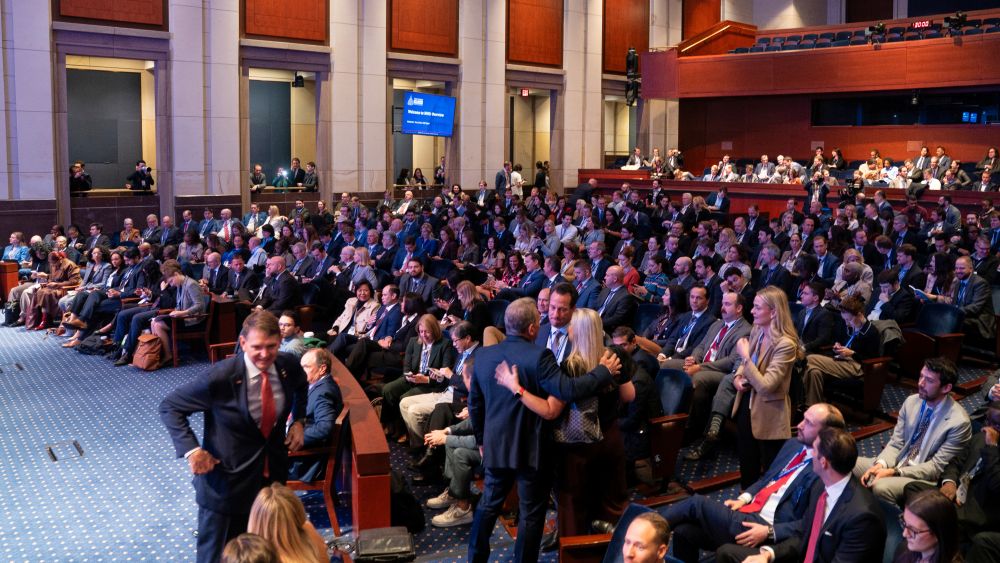
New members of the 120th Congress gather for the first day of new member orientation at the Capitol Nov. 9, 2026, in Washington. (AP/Allison Robbert)

by Michael J. O'Loughlin
NCR CEO & executive editor
Join the Conversation
Send your thoughts to Letters to the Editor. Learn more
With the midterm elections now behind us, in which Democrats resoundingly won back control of the House and Senate — even after being outspent by Republicans — what are Catholics to make of the results?
Bishop Robert Boxie, an auxiliary bishop in Washington, D.C., said the results offer a helpful reminder of how individuals can work together to bring about change even when facing seemingly limitless resources from the rich and powerful.
"We have more power as individuals, as citizens, as parishioners, as members of the body of Christ than we think," Boxie said on a panel on Nov. 9 hosted by the Initiative on Catholic Social Thought and Public Life at Georgetown University.
Boxie, who at 46 is the youngest Catholic bishop in the United States, was asked how Catholics can wield influence in the public square without being corrupted by big money. He pointed to the election as an example of "collective action" triumphing over the wishes of the few.
"We have so much at our own disposal, and the decisions that we make, the things that we support, the positions that we advocate for, the issues that are important to us must be informed by our faith," he said. "Then we have to act from that."
Elon Musk, the richest person in the world, spent nearly $500 million of his own money in the midterm elections, but Boxie said the results showed that, "the billionaires, the trillionaires, all these rich folks, they don't have the last say."
"We do, and that is the power that God has given to his body, the body of Christ, the church, and that includes all of us," he continued. "That is the collective power of you and me."
Like many other groups, Catholics shifted to the left in the midterms, citing economic issues as their primary driver and splitting the vote about evenly between Democrats and Republicans after going for President Donald Trump in 2024. With more political power in store for Democrats, Catholic immigration activists hope for a stronger push to protect undocumented people but questions remain about how U.S. bishops might operate with a Democratic majority in Congress.
For now, analysts are wondering if the results show the resurgence of a religious left, and I remain struck by the varying ways that Catholics participated in the democratic process. As the new political reality takes shape, a few takeaways stand out.
Advertisement
First, Catholic leaders diminish their prophetic role when they are perceived as overtly partisan. NCR reported on perhaps the biggest "October surprise" in the Catholic political world less than two weeks before the midterms, when nearly a dozen bishops were recorded praying over Trump in the Oval Office. A video shared by the White House on Oct. 22 prompted an outcry in some circles, accusing the bishops of staging an endorsement for the Republican Party. In the immediate aftermath, some bishops apologized and one even accused the White House of manipulating the group for political gain.
Next, faith can be an illuminating force in fraught political debates when it's authentic. An encounter between Vice President JD Vance and Sr. Nancy Sylvester, of the Sisters, Servants of the Immaculate Heart of Mary of Monroe, demonstrated this reality. During a town hall style meeting in suburban Detroit on Oct. 15, Sylvester highlighted the harm done to families by the administration's harsh immigration laws. In a reflection for NCR, Sylvester described the encounter as a "graced moment." Sylvester said she's unsure if one encounter will lead to change but in that moment, she said yes to speaking out, not just for her, but "for the immigrants themselves and everyone, especially women religious and other faith-filled people who have been working on immigration for years."
Finally, no single party has a monopoly on the Catholic faith. NCR published an essay from Rep. Jim McGovern of Massachusetts who wrote about how his Catholic faith informs his progressive politics. He recounted meeting Jesuit and Maryknoll priests who taught him that "faith requires action. It demands something of us." He wrote that too often, "Catholic Democrats shy away from talking about our faith this way. That is a mistake."
Those were just a few stories NCR covered ahead of the elections. A Catholic theologian in Texas, Jodi Hunt, challenged James Talarico over his stance on abortion, showing that people of faith can hold different opinions on complex moral issues and still engage in respectful dialogue. Elsewhere, Catholics made their voices known in the ongoing debate over data centers, prayed in vigils and demanded that voting rights be protected, a reminder that Catholics are motivated on a wide range of issues. And we reported a papal first, when Pope Leo XIV continued his "long-standing practice of civic participation" by voting via absentee ballot in Illinois.
Looking ahead to 2028, Catholic political leaders, activists and voters will again be pivotal players in the political arena. Ryan Burge, author of the Substack newsletter "Graphs about Religion," told OSV News that "Catholics aren't a 'locked in' voting bloc," and are "much more malleable" than other faith voters. Catholics have a long history of standing up for the marginalized. Perhaps Catholic leaders will take to heart the lessons of the 2026 midterms and seek more ways, as Boxie said, to exercise "collective power."