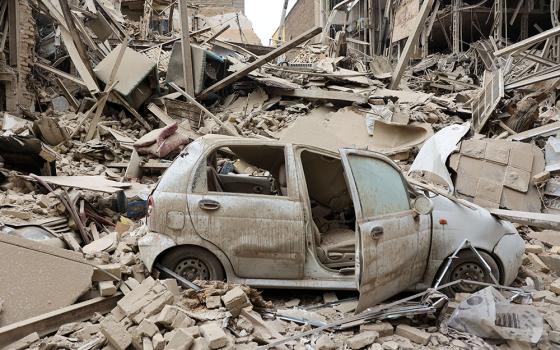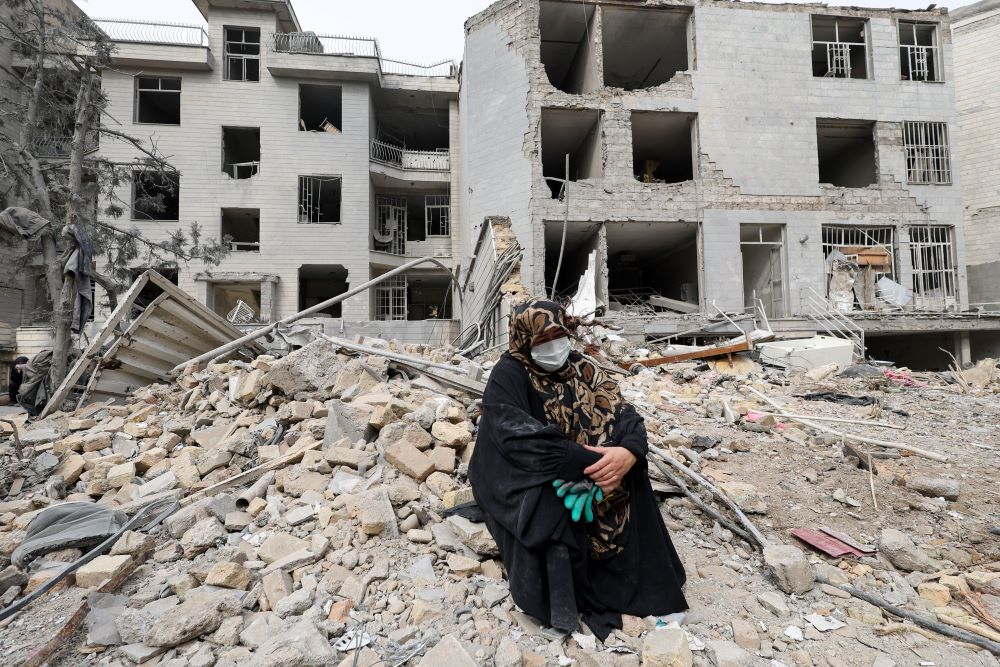
A woman sits amid rubble outside her destroyed apartment in Tehran, Iran, March 12, following an airstrike amid the U.S.-Israeli war with Iran. (OSV News/Reuters/Alaa Al Marjani)

Join the Conversation
Send your thoughts to Letters to the Editor. Learn more
When asked in his only interview to date how he wanted to engage with President Donald Trump, Pope Leo XIV said it would be "more appropriate" for the U.S. church leadership to engage with the administration directly rather than have the pope intervene.
"I would say that about any government," he added.
After the United States and Israel attacked Iran on Feb. 28, provoking a new war in the Middle East, Leo has seemed to put that philosophy into practice.
Since the outbreak of the war, the pope has issued broad calls for peace, but the church's sharp moral critiques of the conflict have come instead from the global College of Cardinals rather than from Rome.
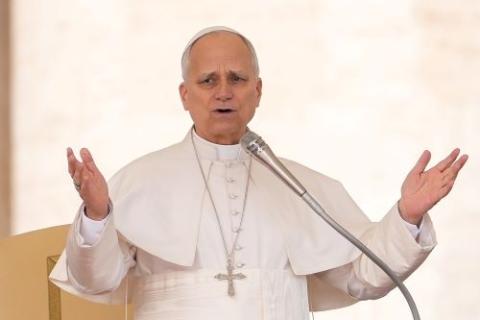
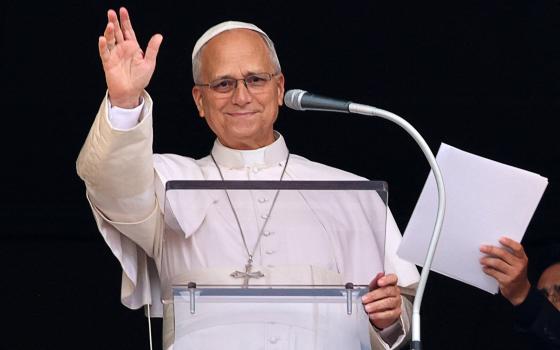
Pope Leo XIV greets pilgrims at the start of his weekly general audience in St. Peter’s Square at the Vatican March 11. (CNS/Lola Gomez)
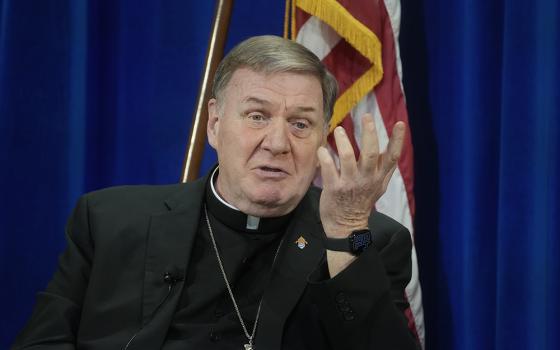
From the U.S. capital, Cardinal Robert McElroy of Washington, D.C., said the U.S. decision to go to war with Iran "fails to meet the just war threshold for a morally legitimate war." Cardinal Blase Cupich of Chicago called the White House's comparison of the war to a video game "sickening" and "a profound moral failure."
Abroad, church leaders have explicitly condemned not only the decision to wage war but also the methods used to conduct it.
Cardinal Domenico Battaglia of Naples, Italy, penned an open letter to the "merchants of death" who profit from the sale of arms calling them to conversion. "The Gospel does not bless industries of destruction," he wrote.
And Cardinal Pablo Virgilio David of Kalookan, Philippines, vice president of the Federation of Asian Bishops' Conferences, condemned warfare which attacks "algorithm-generated targets" from "distant command centers." In its attacks in Iran, the U.S. military has used advanced AI systems to select targets for their missile strikes.
Leo has voiced concern about the conflict but has largely refrained from issuing the sharper moral critiques articulated by other church leaders. Rather than lead the pack, the pope seems to be swimming in their wake.
That approach became evident just four days after the war broke out: Although Leo had already appealed to the warring nations, without mentioning them by name, "to assume the moral responsibility of halting the spiral of violence," he made no mention of the Middle East or the war at his general audience March 4, a venue often used by Pope Francis to issue stark appeals for peace.
Instead, the Vatican published an in-house interview with Cardinal Pietro Parolin, Vatican secretary of state, who issued a sharp condemnation of the notion of preventative war used by the U.S. government to justify the attack.
That move signaled Parolin's continued role as the Vatican's voice on the news of the day in light of Leo's increasingly limited engagement with the press.
Advertisement
At subsequent public appearances, the pope expressed concern that the war's reach would widen and he remembered the Maronite priest who was killed by Israeli tank fire in southern Lebanon.
But those looking for the church's moral assessment of the war itself or its weaponry and methods will have to look beyond the successor of St. Peter.
While it is uncommon for popes to name aggressors in a war in order to preserve the Holy See's ability to serve as a bridge for dialogue, some pontiffs have chosen to depart from that caution on select occasions.
St. John Paul II wrote an open letter to President George H.W. Bush at the onset of the Gulf War in 1991 urging him, "as the leader of the Nation which is most involved," to pursue dialogue in the hopes of preventing Operation Desert Storm.
And Francis appealed to Russian President Vladimir Putin in 2022 to stop the war in Ukraine while describing the Ukrainian people as having suffered "aggression."
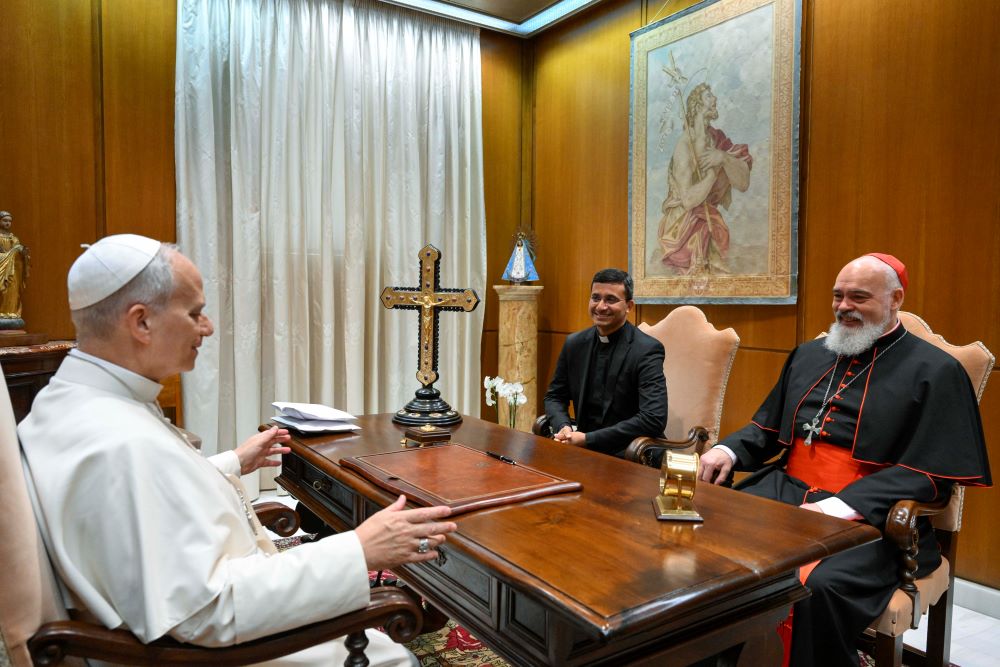
Pope Leo XIV speaks with Cardinal Dominique Mathieu of Tehran-Ispahan, Iran, during a private meeting at the Vatican March 11. (OSV News/Vatican Media/Simone Risoluti)
That's a lever Leo has not yet pulled. He has remained cautious in his appeals for peace, avoiding direct references to the United States, Israel or the Iranian government.
Such restraint could reflect a hope of preserving the Holy See's ability to play a diplomatic role in bringing peace to the region, though the Catholic Church's influence in the Muslim-majority Middle East remains limited.
Still, it is clear the war is on the pope's mind. He met March 11 with Belgian Cardinal Dominique Mathieu, archbishop of Tehran-Isfahan, following his evacuation from Iran. The next day, he received Archbishop Giorgio Lingua, the Vatican ambassador to Israel and Palestine, whom Leo appointed to the post in January.
Yet if Leo's efforts for peace are primarily taking place behind the scenes, his public restraint in condemning the war has opened space for other church leaders to lead that moral charge. So far, several cardinals have moved quickly to fill it.
When the world's cardinals elected Leo to the papacy in May, many pointed to the future pope's capacity for listening as a central part of his appeal. In the early days of a new and uncertain war in the Middle East, it appears Leo wants to hear what they have to say.
The National Catholic Reporter's Rome Bureau is made possible in part by the generosity of Joan and Bob McGrath.