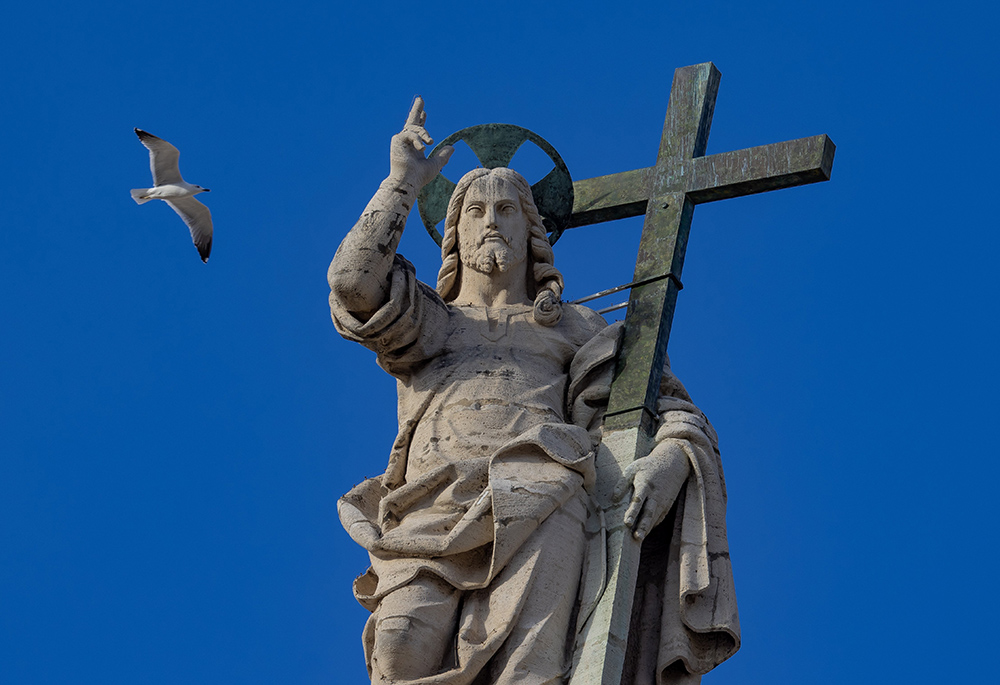
A bird flies over the statue of the Risen Christ on top of the facade of St. Peter's Basilica at the Vatican during Pope Francis' weekly general audience Nov. 13, 2024. (CNS/Pablo Esparza)

by Enzo Del Brocco
Join the Conversation
Send your thoughts to Letters to the Editor. Learn more
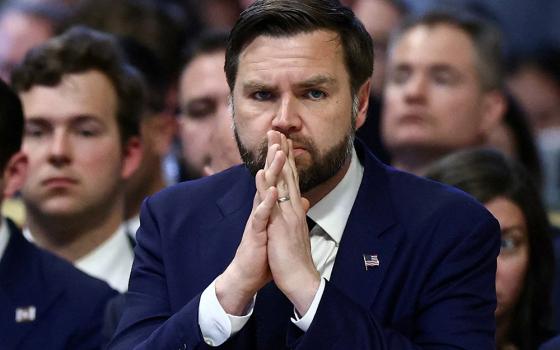
During a recent press conference in Jerusalem, Benjamin Netanyahu, the prime minister of Israel, made a statement that stirred strong reactions. Citing historian Will Durant, he said: "History proves that, unfortunately and unhappily, Jesus Christ has no advantage over Genghis Khan. Because if you are strong enough, ruthless enough, powerful enough, evil will overcome good."
Though later clarified as a reflection on the harsh realities of history rather than an attack on Christianity, the statement invites a deeper theological response. For, in a mysterious and ironic way, it touches the very heart of the Christian message and yet risks missing its truth entirely.
At first glance, the claim seems to align with what St. Paul himself admits in 1 Corinthians 1:23: "We preach Christ crucified, a stumbling block … and foolishness …"
The cross does not look like victory. It does not resemble the triumphs of emperors or conquerors. Christ does not defeat his enemies; he allows himself to be handed over, mocked and crucified.
And yet, Paul continues in 1 Corinthians 1:25: "The weakness of God is stronger than human strength."
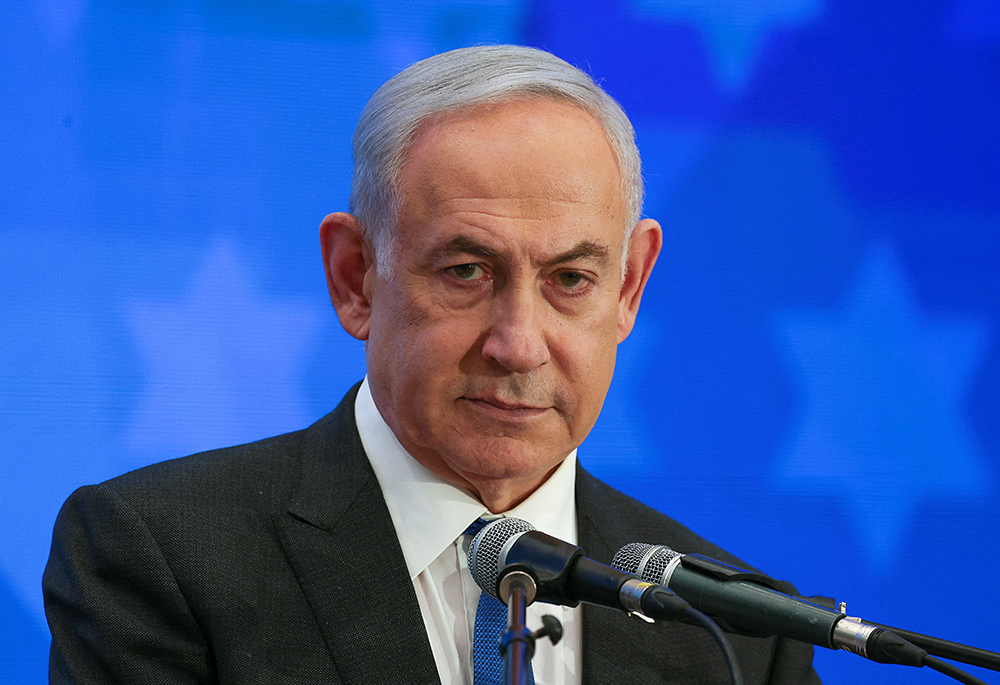
Israeli Prime Minister Benjamin Netanyahu, in a 2024 file photo (OSV News/Reuters/Ronen Zvulun)
Here lies the center of the Christian mystery: What appears as weakness is, in fact, divine power. What appears as defeat is the decisive victory over sin and death.
In his Letter to the Philippians, Chapter 2, Verses 8 and 9, Paul reveals the inner movement of Christ's mission: "He humbled himself, becoming obedient to death, even death on a cross. Therefore God exalted him …"
The path of Christ is not one of domination, but of self-emptying love (kenosis). His exaltation does not come through force, but through obedience and trust in the Father. This is not simply a theological idea, it is the pattern of God's action throughout salvation history.
From the beginning, God reveals himself not through overwhelming force, but through unexpected weakness. Israel itself is chosen not because of its greatness, but because of God's love.
Again and again, the Lord acts through what is small and fragile: A shepherd boy defeats a giant, as David proclaims, "that it is not by sword or spear that the Lord saves" (1 Samuel 17:47); a reduced army wins a battle so that the victory may be known as God's and not man's, when Gideon is told, "the people with you are too many … lest Israel boast" (Judges 7:2); a wandering people becomes the bearer of the divine promise, for the Lord chose Israel "not because you were more numerous … but because the Lord loves you" (Deuteronomy 7:7–8). For, as the Psalm (Chapter 20, Verse 7) declares, "Some trust in chariots and some in horses, but we trust in the name of the Lord our God." The message is consistent: God's power is not like human power.
Advertisement
This reveals something profoundly pastoral for our own time. When faced with fear, insecurity or being outnumbered, the human heart is tempted to seek safety in strength — in control, influence or force. This temptation is universal. It can touch individuals, nations and even communities of faith.
On the surface, such a response may seem prudent, even necessary. But Scripture gently warns us that this path carries a spiritual danger: It risks replacing trust in God with reliance on ourselves.
The people of God — both in the Old Covenant and in the fullness revealed in Christ — are not defined by their ability to secure themselves, but by their willingness to trust.
"Not by might, nor by power, but by my Spirit, says the Lord" (Zechariah 4:6).
The cross stands as the ultimate revelation of this truth. Christ does not overcome evil by surpassing it in force, but by transforming it. He enters into suffering and redeems it from within. He allows death, and in doing so, destroys its power.
This is why the martyrs hold such a central place in the life of the church. They do not resist evil with violence. They do not "win" in the eyes of the world. Yet their witness proclaims a deeper victory — the victory of faith, of love, and of truth.
History itself, when seen more deeply, offers striking confirmations of this Gospel logic. Again and again, individuals who embraced nonviolence, humility and truth — often inspired directly or indirectly by Christ — have transformed the course of history far more enduringly than those who relied on force.
The early Christians, through witness and martyrdom, overcame the Roman Empire not by the sword, but by faith; Benedict of Norcia helped rebuild a collapsing civilization not through power, but through prayer, work and community; Francis of Assisi renewed the church through radical poverty, peace and love of all creation; Catherine of Siena, without armies or office, spoke truth to power and helped guide the church in a time of crisis; Mahatma Gandhi led a movement of nonviolent resistance that changed the fate of a nation; Martin Luther King Jr. confronted injustice not with weapons, but with truth, courage and sacrificial love rooted in the Gospel; and Nelson Mandela, after years of imprisonment, chose reconciliation over revenge, helping to heal a divided nation.
None of these figures "won" by domination. Their strength lay in moral truth, perseverance and a willingness to suffer rather than inflict suffering. Their impact continues to shape the world long after the power of their opponents has faded.
The irony in the original statement, then, becomes even clearer.
If one judges history only by visible, immediate victories, then yes — Christ appears to have "no advantage." But when history is seen in its fullness, a different pattern emerges: It is not violence, but truth; not domination, but love; not fear, but sacrifice that endures.
Genghis Khan conquered lands. Christ conquered death.
And in the light of the Resurrection, we come to see that what seemed like weakness was the greatest strength, and what seemed like loss was the beginning of eternal victory.
For the Christian, this is not only a truth to be believed, it is a path to be lived. To follow Christ is to trust that even when goodness seems to suffer, even when truth seems overshadowed, even when love appears to lose, God is at work in a deeper way.
And in the end, it is not power, but love — crucified and risen — that has the final word.