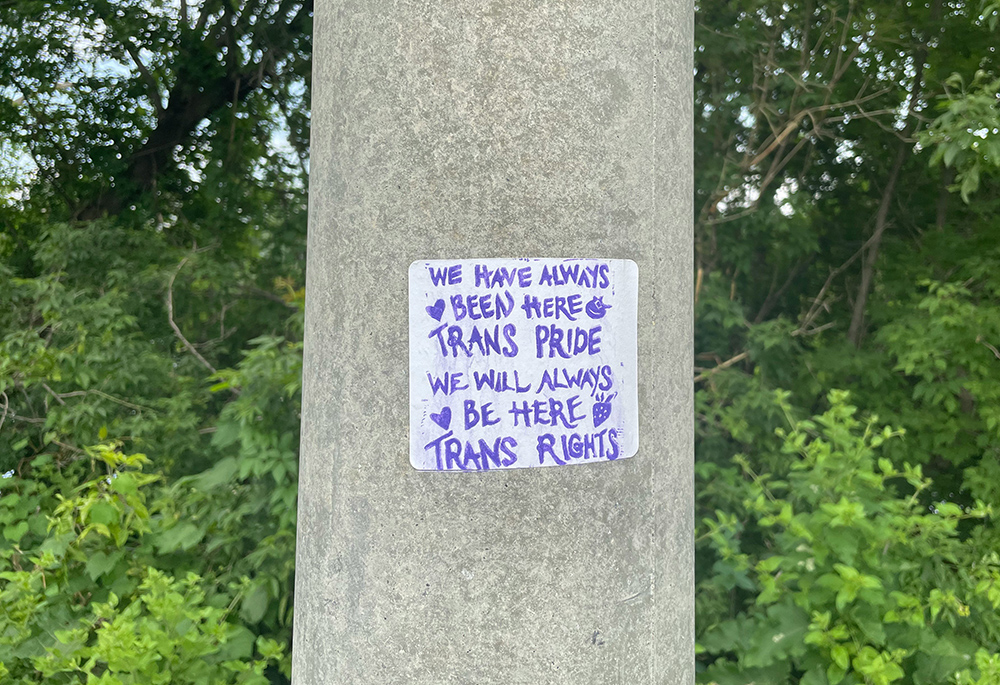
(Unsplash/charliewarl)

by Maxwell Kuzma
Join the Conversation
Send your thoughts to Letters to the Editor. Learn more
Visibility for the transgender community has always contained both joy and sorrow. To be visible and trans often means to experience a profound embodied freedom, yet face exclusion, rejection and threats of violence from a society that aggressively polices heteronormativity. This is especially true for the most marginalized and vulnerable members of the trans community — those without familial or financial support structures, who face systemic racism (in addition to transphobia) and barriers to accessing even the most basic health care.
Despite being such a small percentage of the overall population, trans people are incredibly scrutinized and targeted by politicians hoping that sponsoring severe legislation against a tiny group of people will distract from their failures to materially improve conditions for everyone else. One of the clearest mottos for this strategy would be Donald Trump's oft-repeated "transgender for everybody," which he has uttered 50 times since taking office in 2025. By comparison, as GLAAD reported in February, the president has mentioned "affordability" less than 25 times since taking office for the second time, despite data showing that cost of living is voters' top concern, and the majority of the country disapproves of the president's handling of the economy.
In fact, Trump capitalized on the coincidental timing of Transgender Day of Visibility in 2024 (which is always on March 31) with Easter Sunday (which changes every year to coincide with the first Sunday after the full moon that occurs on or after the spring equinox) by issuing the executive order "Eradicating Anti-Christian Bias," which targeted so-called "transgender ideology." The administration also posted an unrelated image of a topless transgender woman from a White House pride event in 2023, while claiming erroneously that the Biden administration established Transgender Day of Visibility in 2024. No doubt much of Trump's ire about Trans Day of Visibility itself stems from the fact that Joe Biden was the first American president to issue a formal presidential proclamation recognizing the event.
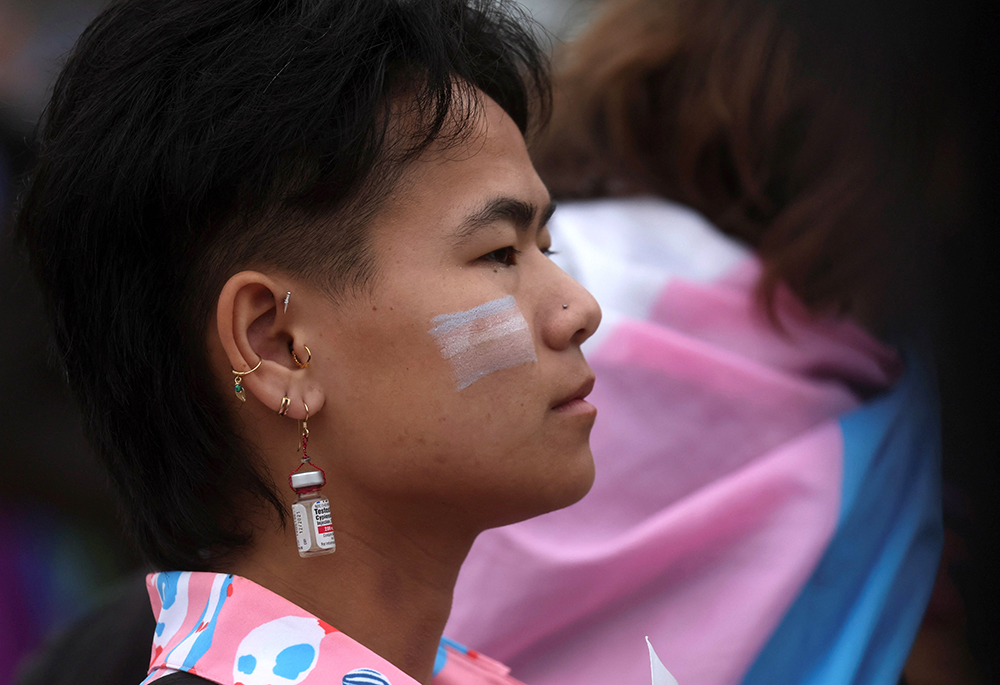
A young person listens to a speech as protesters gather after a "March for Queer and Trans Youth Autonomy" in Washington, March 31, 2023. (OSV News/Reuters/Leah Millis)
This year, members of the queer and trans community are reeling from the pain of being visible in the crosshairs of a hostile government. With Donald Trump in the White House once again, the flood of anti-LGBTQ (and anti-trans specifically) bills being proposed and passed across the country have only intensified in number and severity.
The news is full of efforts that ultimately seek to legislate transgender people out of public life altogether: executive orders that deny trans identities and demand passports be issued only in a person's birth sex; the dismantling of suicide hotlines; the state of Kansas' enacting of bathroom bans and revocation of driver's licenses not only from trans people who changed their gender marker but also from those who simply changed their name; the Supreme Court's decision in United States v. Skrmetti permitting medical discrimination based on "gender dysphoria"; the recent ruling from the Fourth Circuit U.S. Court of Appeals that states can compel trans adults to "appreciate their sex" via care bans. This ruling seems to be following the playbook outlined by Heritage Foundation President Kevin Roberts, a Catholic, who recently appeared on a podcast discussing plans to ban gender-affirming care for all ages, through a process he has described as "radical incrementalism," with his final solution: "You outlaw it."
Transgender Catholics also face scrutiny from their own church. In January 2025 the U.S. bishops' conference praised Trump's executive orders for "recognizing the truth about each human person as male or female," failing to appreciate the danger of stripping away the legal rights of a vulnerable minority by invalidating their passports. In November 2025, the bishops voted to ban gender-affirming care at Catholic hospitals across the country. These facilities account for roughly one in six hospital beds in the U.S. and are present in all 50 states, therefore impacting many people who are not Catholic and have no other accessible options for health care.
A doctor holds a stethoscope in this illustration photo. (OSV News/Reuters/Regis Duvignau)
Finally, on Feb. 17, 2026, the bishops devoted a considerable amount of time in their annual report on U.S. religious liberty to "gender ideology," a phrase they use to encompass an extremely wide range of different ideas and experiences, despite these groups and individuals not sharing a singular ideology. When discussing the Annunciation Catholic School shooting in Minneapolis and the assassination of Charlie Kirk, the report acknowledges that the perpetrators' motives are uncertain, yet still foregrounds speculative connections that risk reinforcing a broader narrative that transgender identity is linked to social instability or violence. While more cautious than the overt claims promoted by organizations such as the Heritage Foundation, this framing nonetheless lends institutional credibility to patterns of insinuation that amplify public suspicion toward an already vulnerable minority.
All of this makes it worth remembering why Transgender Day of Visibility was created in the first place. The day was established in 2009 by Rachel Crandall-Crocker, co-founder of Transgender Michigan, in response to a media environment where stories about transgender people were overwhelmingly framed through violence, scandal or tragedy. Crandall-Crocker envisioned a day that would highlight the ordinary humanity, achievements, and lives of transgender people — while also acknowledging that because of discrimination and safety concerns, not every trans person can or wants to be visible. Positive visibility matters because it reminds the broader public that transgender people are not abstractions or political talking points, but neighbors, coworkers, family members and friends whose lives contain the same hopes, struggles and dignity as anyone else's.
Advertisement
At the same time, visibility has another function: It reveals what is happening beneath the surface of a society. The intensity with which transgender people are currently targeted in politics and media should concern more than just the trans community. Throughout history, the erosion of the rights of small and vulnerable minorities has often served as an early warning sign. When governments test how far they can go in restricting the freedoms of one marginalized group, it rarely stops there. Normalizing discrimination against a minority trains the public to accept the gradual narrowing of rights and belonging for others as well.
From the perspective of human dignity, this should also give us pause. In recent years, many American Catholics have chosen not to stand alongside transgender people facing discrimination, but to align themselves with political efforts seeking to erase them from public life. When institutions that speak so often about the sanctity of human dignity support policies that strip legal recognition, restrict health care, or portray an entire group as a threat, they risk abandoning the very moral principles they claim to uphold. If Transgender Day of Visibility means anything in this moment, it is not only a celebration of trans lives, but a reminder that the dignity of any society is measured by how it treats those who are most vulnerable within it.