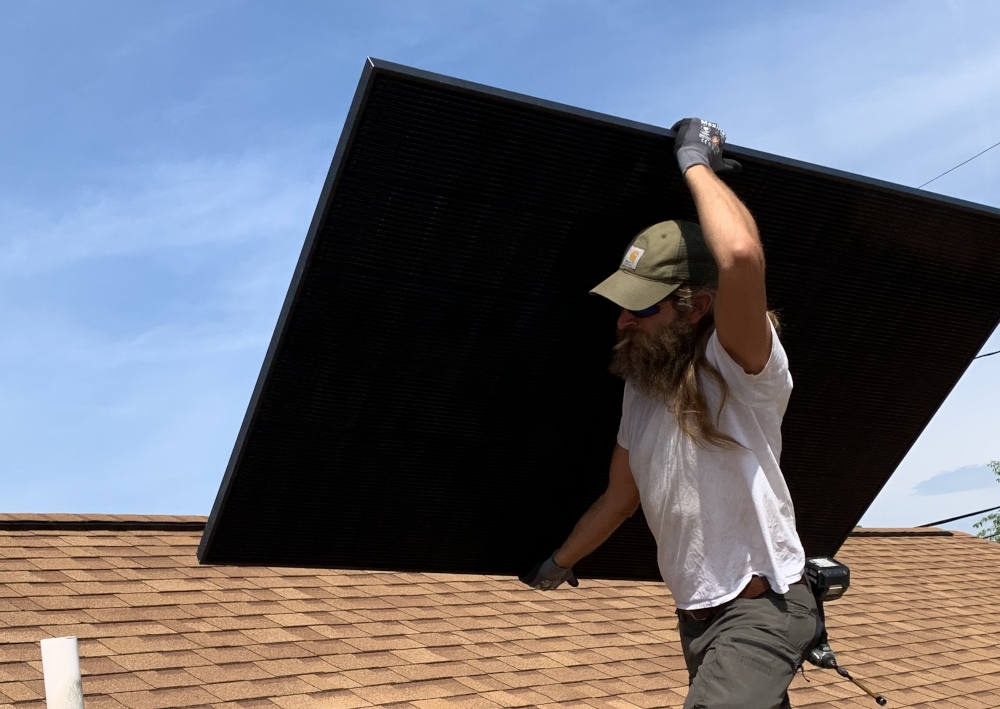
A worker carries a solar panel atop the roof of Mother of Good Counsel Catholic Church, in Hazard, Kentucky. The Appalachian mission parish completed the solar installation in May 2026. (Lexington Diocese/Joshua Van Cleef)

Join the Conversation
Send your thoughts to Letters to the Editor. Learn more
For Franciscan Fr. Michael Surufka, the clock is ticking.
On July 1, he will depart as pastor and rector of the Cathedral of the Holy Angels in Gary, Indiana. His exit will bring to an end seven years of Franciscan presence in the northern Indiana diocese.
As he wraps up his ministry in Gary, an industrial city of about 67,000 people located 30 miles southeast of Chicago, Surufka is also racing to meet another deadline, one tightened last year when Congress shrank by five years the window for federal funding for clean energy.
The Republican tax law now requires most solar and wind projects to finish by the end of 2027 to qualify for federal energy credits, but allows a two-year extension if by July 4, 2026, projects demonstrate "significant" construction has begun or procure at least 5% of the total costs for smaller solar arrays.
The availability of the credits — a minimum 30% project cost-savings and as much as half — has made it financially viable for the cathedral to consider solar power, an idea on its merits that has long aligned with Catholic teaching, Surufka said.
"There's no question that this is consistent with what the church has been asking us to do and to be responsible stewards of creation for a long time," the Franciscan told EarthBeat.
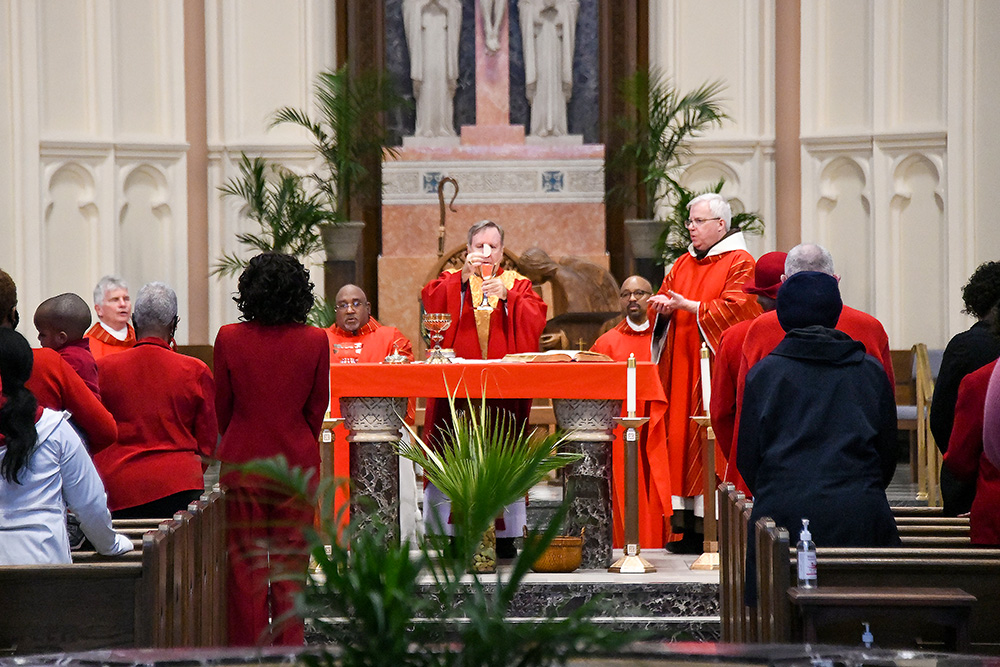
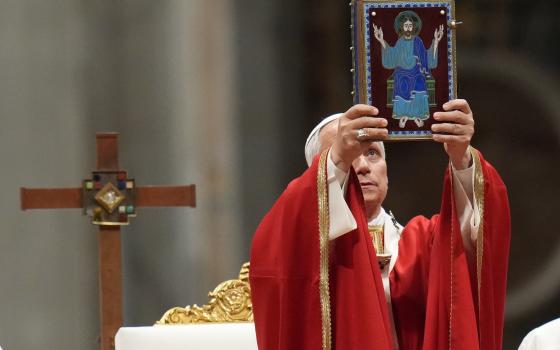
Bishop Robert McClory of Gary, Ind., raises the host and chalice during Mass at the Cathedral of the Holy Angels in Gary April 10, 2022, as Franciscan Fr. Michael Surufka concelebrates. (CNS/Northwest Indiana Catholic/Anthony D. Alonzo)
With 2026 marking 800 years since the death of St. Francis of Assisi, the patron saint of ecology, Surufka sees a potential solar project as a lasting Franciscan imprint on the area, a reminder of the Christian duty to be concerned with ecological matters like climate change affecting God's creation.
"This is for me personally like a final Franciscan legacy to leave with the diocese and the cathedral campus," he told EarthBeat.
That's if they can meet the deadline.
The cathedral of the Gary Diocese is one of dozens of Catholic institutions across the country, including in politically red states, sprinting to develop solar projects to the point that they meet federal tax credit requirements before they go away.
"Urgency is always a good driver of behavior," said Ian Moise, director of Catholic Energies, a project of the Catholic Climate Covenant working with more than two dozen Catholic institutions to advance projects ahead of the July 4 deadline.
Advertisement
Tax law claws back climate funds
A year ago, Republicans passed along party lines the One Big Beautiful Bill Act, a sweeping domestic policy and tax-cut bill that clawed back billions in federal tax incentives for clean energy and climate initiatives included in the 2022 Inflation Reduction Act. The 2022 law, signed by President Joe Biden, had allocated more than $300 billion over a decade for clean energy, representing the largest federal investment in climate action.
The Inflation Reduction Act also opened for the first time a pathway for tax-exempt organizations, including religious organizations, to receive federal clean energy tax credits through a program called Direct Pay. The clean energy credits cover a base of 30% of a project's costs and an additional 10% each for using union labor and building in low-income areas or energy communities.
Those credits, originally set to expire in 2032, now phase out at the end of 2027, requiring most commercial solar and wind projects by that time to connect to the electric grid to qualify. The 2025 tax law allows two exceptions to extend the deadline until the end of 2029: before July 5, start a project's construction, defined as "when physical work of a significant nature begins," or for solar projects smaller than 1.5 megawatts spend at least 5% of the total costs, a process known as "safe harboring."
Through its Solar Urgency Now (SUN) initiative, Catholic Energies has worked to help Catholic institutions take advantage of the federal credits before they expire. At one point more than 80 had reached out expressing interest. From that list, Catholic Energies says, it is actively assisting 29 clients, with roughly half aiming to complete construction by the end of 2027.
The rest have either safe-harbored or are in process to do so, said John Dewan, whose Dewan Foundation is the managing agent for Solar Urgency Now.
Dewan, a secular Franciscan, said Catholic Energies views switching to solar power as a way for Catholics to live out their faith and the calls for safeguarding creation expressed by Pope Francis in his 2015 encyclical, "Laudato Si', on Care for Our Common Home."
"We see this as you can save money on electric costs, and you can save the planet, too," he said.
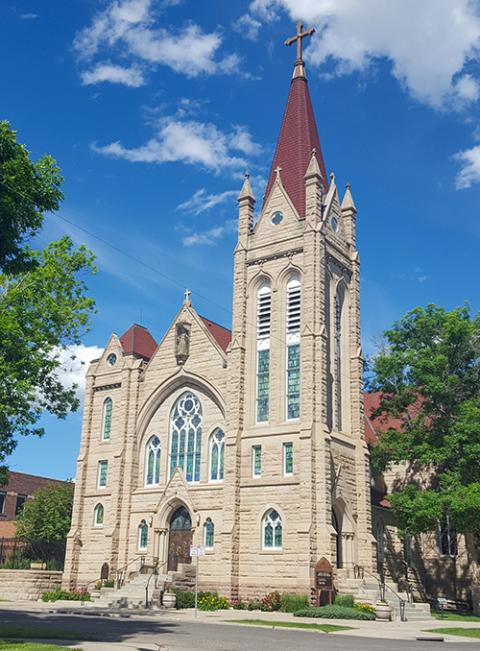
St. Ann's Cathedral in Great Falls, Montana (Wikimedia Commons/Always dreamin)
The Great Falls-Billings Diocese in Montana is among those taking the safe-harbor route. It has made a down payment on 10% of a $304,000 multi-building solar project. The system over 30 years is projected to save the diocese $1 million in energy costs, according to projections from the solar developer.
Amber Henning, the diocese's in-house counsel and properties manager, said the federal energy credits were crucial in making solar power a reality.
"Without that, I mean, it would take a lot more planning, as far as finding additional grant sources and funders. And so it just makes the process easier and not like a 10-year project but a one-year project," she said.
The 30% federal credit, combined with a similar grant it is seeking from its utility Northwestern Energy to cover as much as half of the cost, means the diocese's share of the project's cost could amount to approximately $60,000, Henning said.
Racing to beat the deadline
Like Henning, Doug Rich learned more about Catholic Energies and the federal credits deadline during a January workshop for the first cohort of a Laudato Si' training program for dioceses. The director of schools and parish services for the Diocese of Yakima, Washington, Rich said the federal assistance offered a more direct path to solar power than other options they had explored.
The Yakima Diocese is finalizing a contract for a 110-kilowatt solar array at its 88,000-square foot mission center, he said. It intends to safe-harbor 7% of the costs and once completed, apply for a 40% federal energy credit.
"Without that, I don't know that we would be doing this," Rich told EarthBeat. "We certainly wouldn't be doing this quickly."
The shorter availability of the federal credits limited the diocese's solar plans, he added.
"We had a couple of other buildings in mind, and we just simply didn't have the time to manage all of them," Rich said.
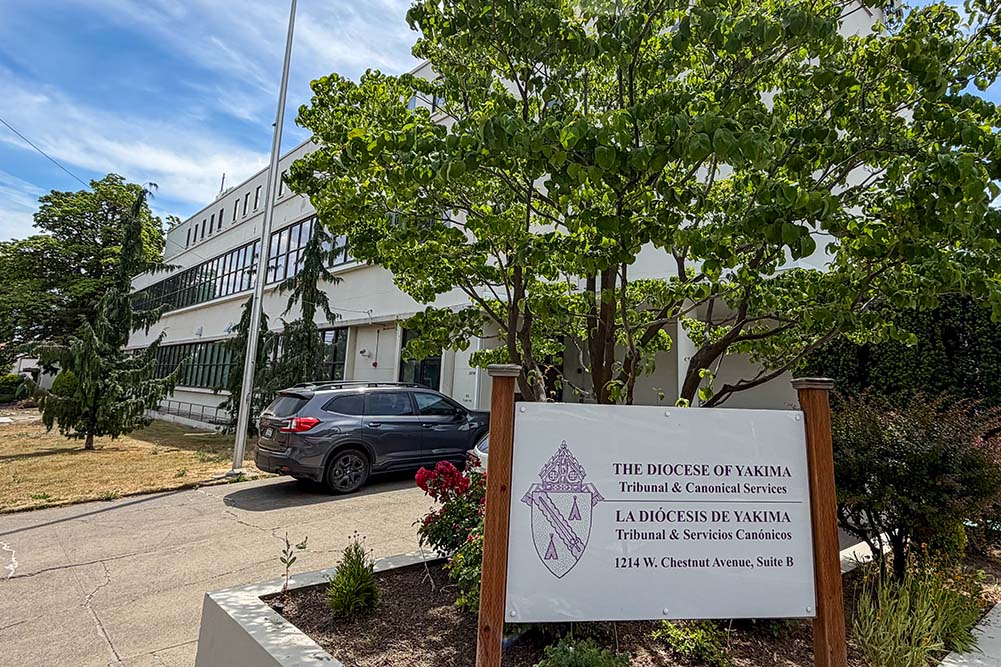
The Diocese of Yakima, Washington, is pursuing a 110-kilowatt solar installation on the roof of its mission center. (Courtesy of Yakima Diocese/Msgr. Robert Siler)
In the Diocese of Lexington, Kentucky, staff and parishes are speeding to install solar power in as many places as possible. They see the federal tax credits as a key element in its plans to reach net-zero carbon emissions by 2030, the first U.S. diocese to make such a pledge.
"We've already had kind of a sense of urgency built into this," said Josh Van Cleef, director of Lexington's peace and justice office. "It definitely makes it even tighter for us to do this. It has shortened our windows significantly so, I would say."
Currently, the mission diocese in eastern Kentucky's Appalachia region has 10 solar projects completed, three under contract, and 16 more reviewing proposals with solar vendors, Van Cleef said. It is hoping to do more wherever it can.
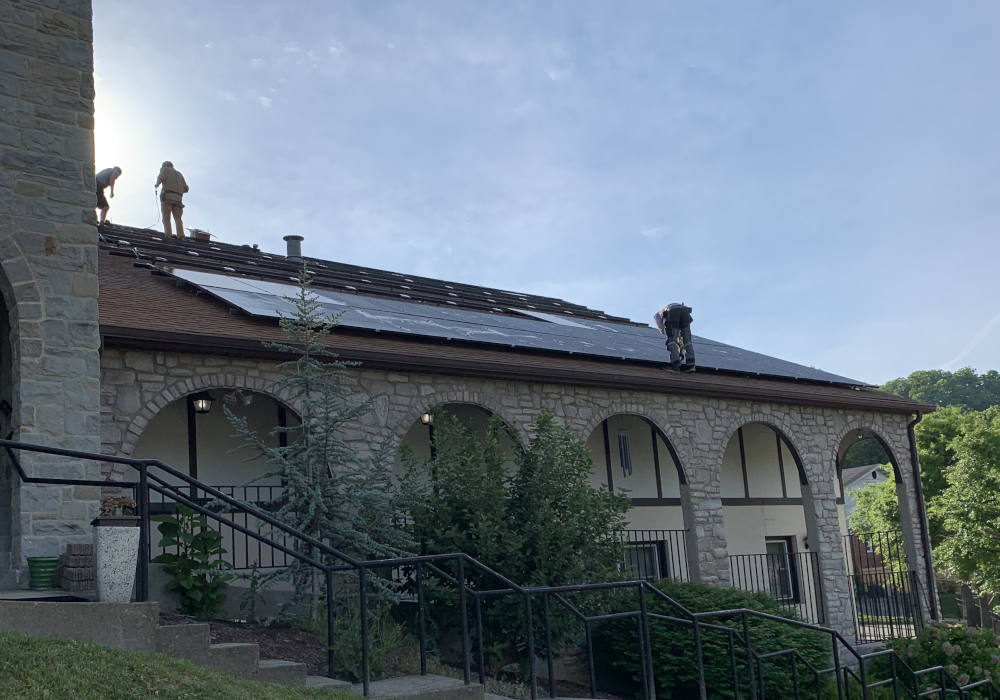
Workers install a solar array on the roof of Mother of Good Counsel Catholic Church, in Hazard, Kentucky, in May 2026. It is one of nearly 30 solar projects completed or in process in the Lexington Diocese. (Lexington Diocese/Joshua Van Cleef)
The Lexington Diocese has focused on completing projects by Dec. 31, 2027, to receive the federal credits. It has offered parishes grants for solar through funding it has received from organizations like Catholic Extension Society, Franciscan Sisters of Mary, Porticus, the Dewan Foundation and Catholic Energies.
"Many of our parishes in Eastern Kentucky would not be able to do this without accessing these tax credits, because this is a significant reduction in cost for them," said Van Cleef, adding its projects are each aiming to recoup 50% cost reductions through the federal credits.
The shorter deadline has meant not just limited time for projects to be built, but also narrows the timeframe for parish and financial councils to discuss the possibilities, review the details and seek out fundraising or funding sources, Catholic officials said. It also creates space for mistakes.
"It does make me nervous when you have to perform quickly because you want to make sure that you do everything right," Rich said.
Right now, the Yakima Diocese is parsing through the details of its project contract with its attorney, checking that all the T's are crossed and I's dotted with just days to go before the critical July 4 cutoff date.
"We're hoping that we're going to be able to beat the deadline," Rich said. "We think we can, but we're not there yet."
Editor's note: This story has been updated to revise the solar project figures for the Diocese of Lexington, Kentucky.