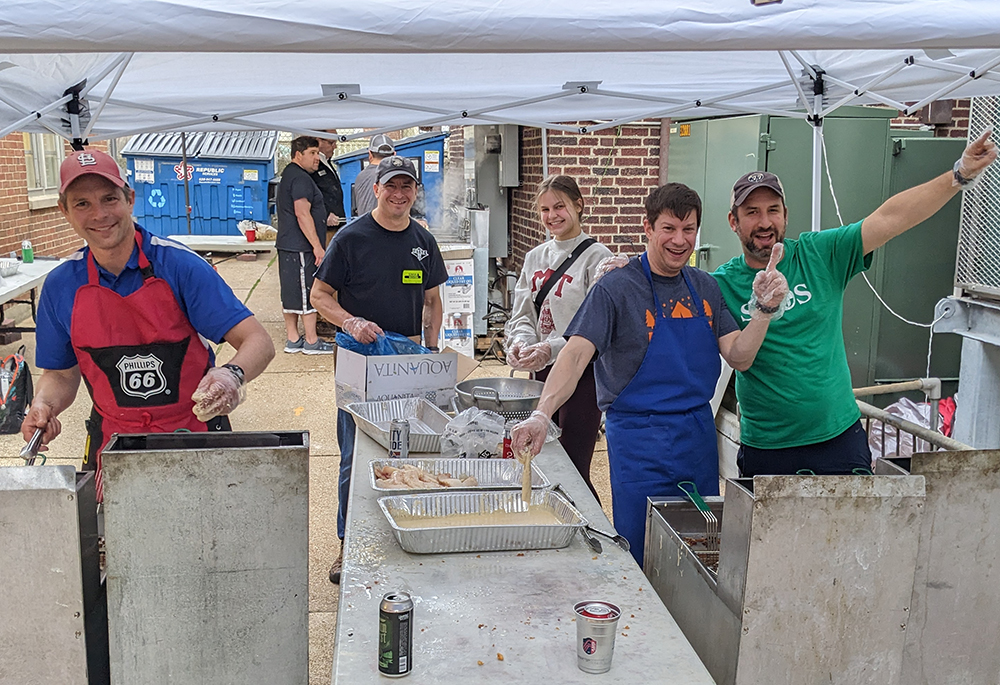
A team of parishioners cook fish at the annual Lenten fish fry at St. Margaret of Scotland Catholic Church, in St. Louis, March 31, 2023. This year, the parish for the first time will compost leftover food and compostable materials in an effort to reduce waste thanks to a grant from the St. Louis Archdiocese's Laudato Si' Commission. (St. Margaret of Scotland Catholic Church)

Join the Conversation
Send your thoughts to Letters to the Editor. Learn more
For many Catholics across the country, the season of Lent is synonymous with the scents, sights, tangs and tastes of the parish fish fry.
In the St. Louis Archdiocese, though, it's more than just a weekly meal without meat.
"A cultural touchpoint," said Jamie Hasemeier, a parishioner at Holy Redeemer Catholic Church, in Webster Groves, Missouri. "It's just part of the DNA."
A map on the archdiocesan website marks 53 parishes and schools hosting fish fries this year, listing times, dining options and of course the menu. For some, the locator icon is green — indicating a parish that with the help of an archdiocesan grant has taken steps to lessen the waste associated with serving hundreds, and in some cases, 1,000 meals in a single night.
One of those parishes is Sacred Heart Catholic Church, in Valley Park. Its green team has used its $500 grant to move from plastic cups and dessert boats to compostable alternatives.
"That Laudato Si' grant really helped because I didn't know how we were going to get the money," said Karen DuBrucq, who facilitates the green team at Sacred Heart.
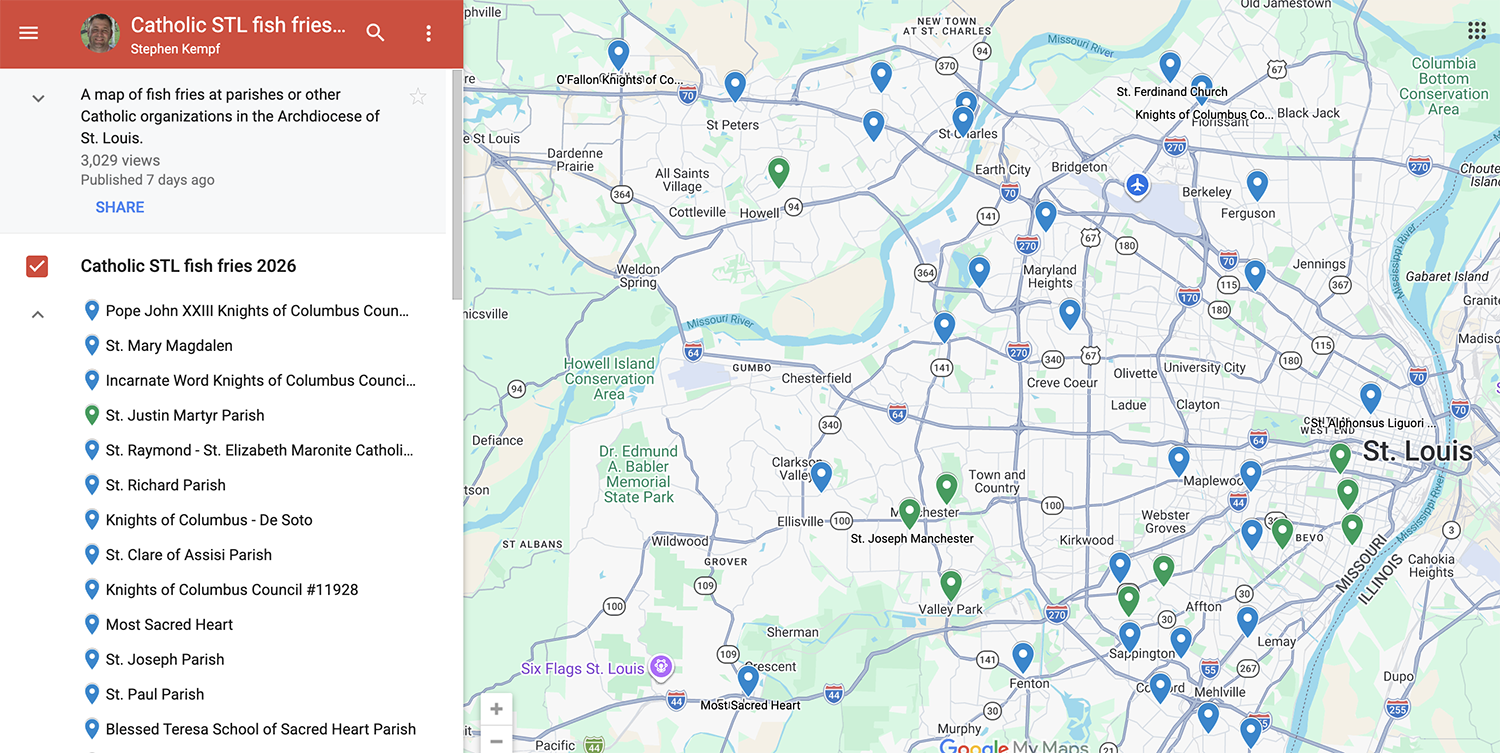
A map created by the St. Louis Archdiocese displays 53 parishes hosting fish fries during the 2026 Lenten season. Parishes marked with a green icon received a grant from the archdiocesan Laudato Si' Commission to reduce waste at the Friday meatless meals. (NCR screenshot)
Frying on faith
The idea to reduce waste at fish fries originated from the archdiocese's Laudato Si' Commission.
Begun in 2023 with the support of Archbishop Mitchell Rozanski, the 20-person group works to educate and mobilize Catholics in St. Louis around church teaching on the environment, including Pope Francis' 2015 encyclical "Laudato Si', on Care for Our Common Home." The effort also is part of its interfaith outreach, recognizing ecological concern as a shared value across religions. Along with an annual summit and a speaker series, the commission awards microgrants to assist parishes in putting creation care into practice.
The first grants in 2024 were directed toward general sustainability projects like energy-efficient light bulbs, vegetable gardens and native plants. Wanting to give the next round a particular focus, they quickly homed in on the popularity of fish fries.
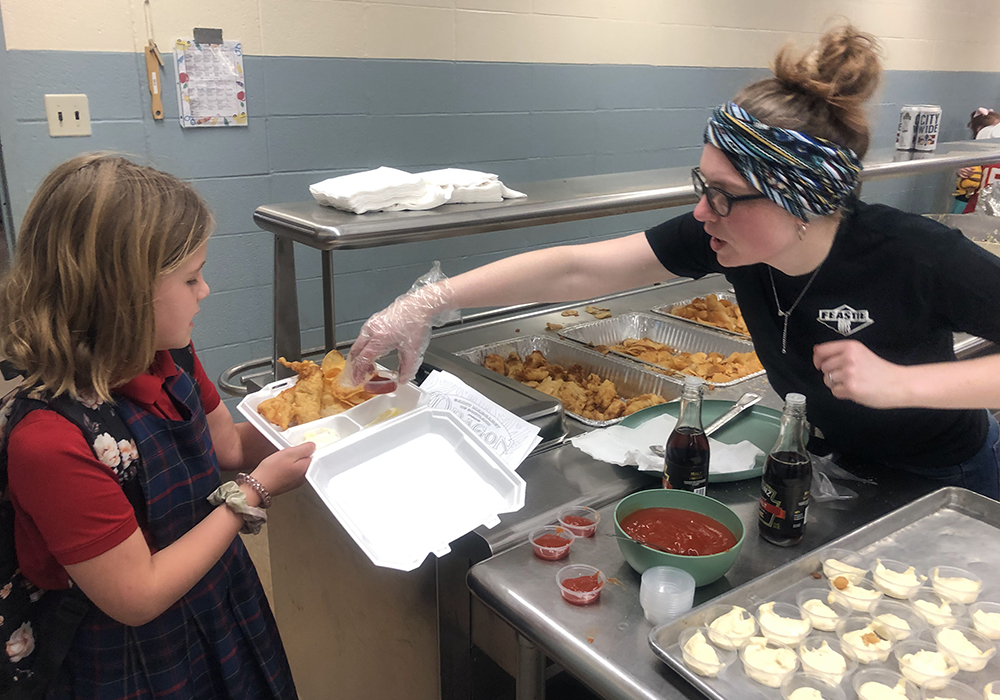
A student waits to be served during the Lenten fish fry at St. Margaret of Scotland Catholic Church in March 2023. (Courtesy of St. Margaret of Scotland Catholic Church)
"We said, 'Wouldn't this be a great way to lift up sustainability work and also be a way to start some conversations with non-Catholics about, hey, this is part of Catholic teaching, too. Caring for the earth and caring for our neighbor go together,' " said James Fowlkes-Comninellis, director of the archdiocese's ecumenical and interreligious affairs who leads the Laudato Si' Commission.
The commission awarded a total of $5,000 through 15 grants ranging from $300 to $800 each. Most of the parishes have applied the funds to compostable servingware, while one aimed to shift fully toward reusable items. Three used the grants to partner with commercial composting services. Each parish also received educational materials on composting and Catholic teaching to display at the fry.
At Holy Redeemer, the grant has helped purchase compostable plates, cutlery and to-go containers.
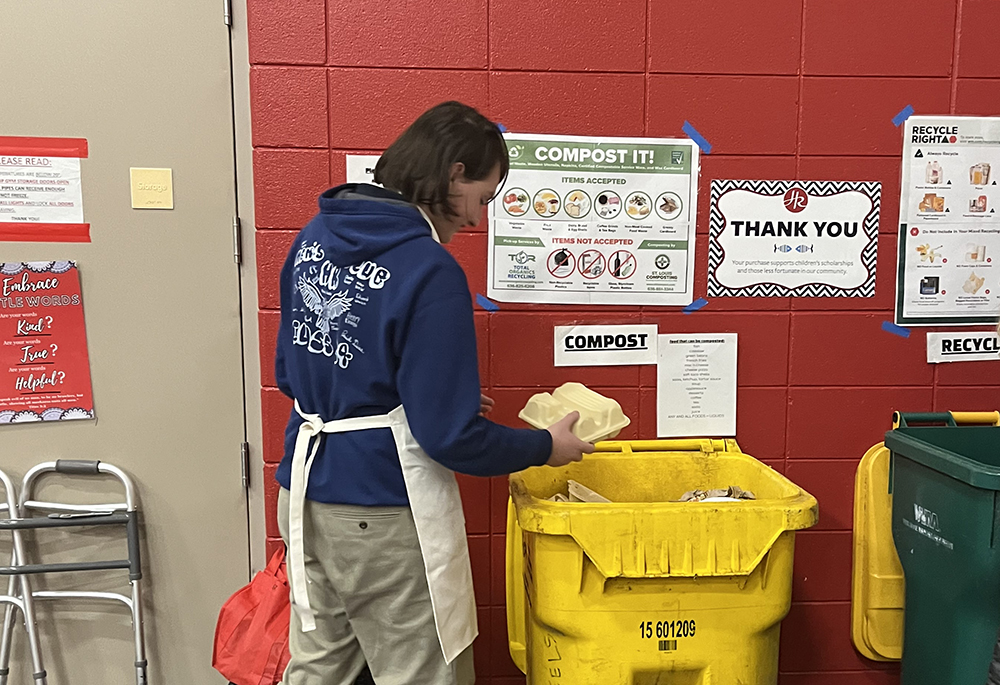
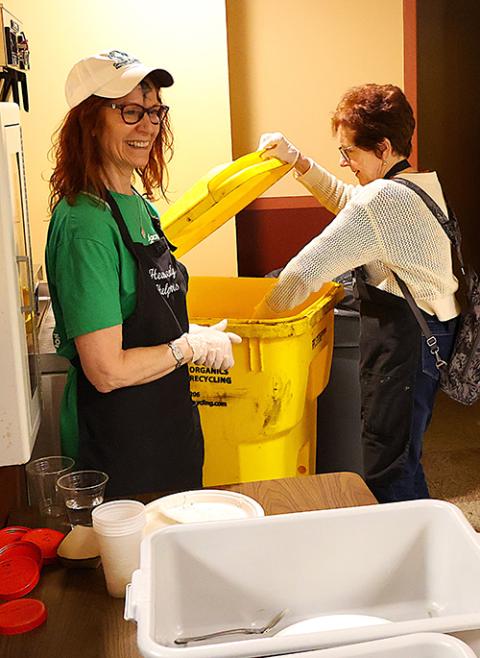
A parishioner at Holy Redeemer Catholic Church, in Webster Groves, Missouri, places a compostable food container into a compost bin during a Lenten fish fry. Holy Redeemer was one of 15 parishes in the St. Louis Archdiocese to receive a grant to help reduce waste at the Friday meatless meals. (Jamie Hasemeier)
"Taking this step is an act of love, you know, not just for the health and well-being of Earth today and people today but in the future as well," said Hasemeier, who started the parish's creation care ministry in 2016 and now serves as administrative coordinator for the Laudato Si' Commission.
St. Margaret of Scotland Catholic Church, in St. Louis, used its grant funds to pay for a composting service as well as compostable materials for its one fish fry set for March 13.
"We've done our best to reduce waste and recycle our cooking oil, but we were never able to hire a composter and we were never able to get as many compostable goods as well, just because they were too expensive for us," said Joanna Wingbermuehle, who chairs the parent teacher association committee that runs the fish fry."
"I think the archdiocese is really putting their money where their mouth is, and showing that they care about this, to be giving money and making these fish fries more sustainable," she said.
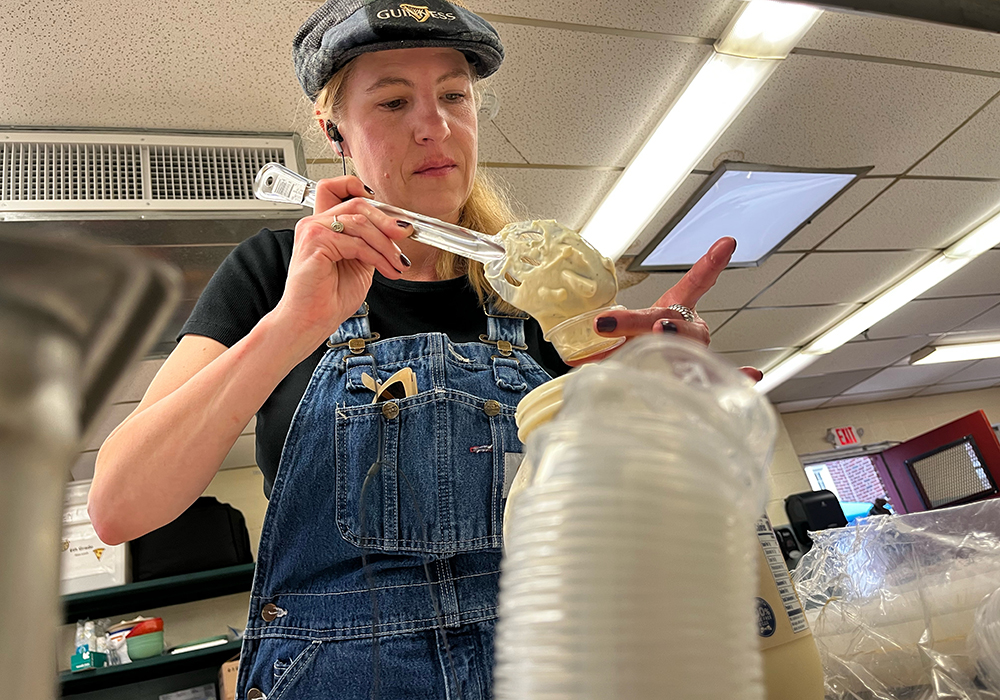
A parishioner at St. Margaret of Scotland Catholic Church, in St. Louis, scoops tartar sauce into individual plastic containers during the annual Lenten fish fry March 31, 2023. This year, with the help of a grant from the St. Louis Archdiocese's Laudato Si' Commission, the parish for the first time will compost leftover food and compostable materials in an effort to reduce waste. (Courtesy of St. Margaret of Scotland Catholic Church)
Composting and Catholic values
Fish fries presented fertile ground to target with sustainability grants, with such large parish gatherings prone to producing a lot of trash that eventually heads to landfills: single-use plates and cups, much of it often made from plastic foam, individually wrapped plastic utensils, disposable napkins, plastic-shell to-go containers, not to mention leftover food scraps. Multiply all those discards across hundreds of fish fries across the archdiocese during the six-week Lenten season and the picture quickly becomes clear.
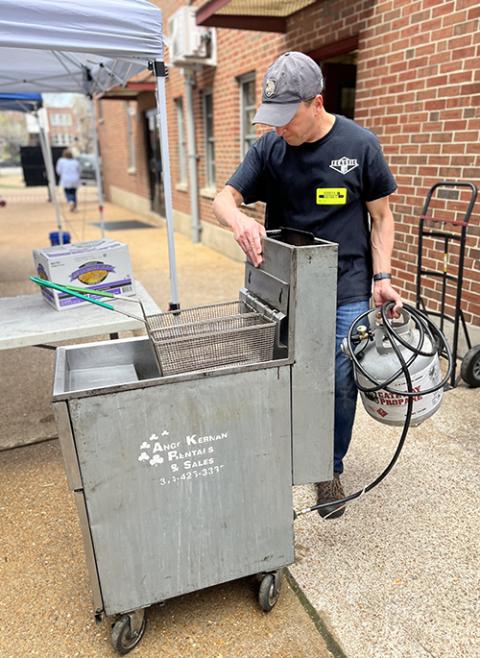
A parishioner at St. Margaret of Scotland Catholic Church preps the oil fryer for the annual Lenten fish fry in March 2023. (St. Margaret of Scotland Catholic Church)
"Most people see the waste in the fish fries," said DuBrucq, who is also a member of the archdiocesan Laudato Si' Commission.
The Lenten gatherings also presented a setting to put in practice Catholic values and teachings on the environment, including those articulated by Francis. Throughout his 12-year pontificate, the Argentine pope routinely critiqued the "throwaway culture" and the cruelty of food waste in a world where hundreds of millions people go hungry.
Overcoming the environmental and social crisis of our time, Francis said in a 2023 address, "requires a determination to overcome the 'throwaway' culture of waste generated by present-day consumerism and by a globalized indifference that inhibits efforts to address these human and social problems in the light of the common good."
In the U.S. alone, more than 130 billion pounds of food — approximately 30%-40% of the total food supply — is wasted annually at the retail and consumer levels. Meanwhile, the vast majority of the country's discarded plastics, which are primarily made from fossil fuels, end up in landfills, waterways or incinerators, with a slew of negative health impacts for both people and ecosystems.

The Laudato Si' Commission of the St. Louis Archdiocese produced educational materials for parishes to display at their fish fries explaining and encouraging sustainability measures. (Courtesy of St. Louis Archdiocese)
"We got to remember the prayer aspects that come into this [sustainability work], not just how to do it, but also why we do it and what it does for our soul in doing it," Fowlkes-Comninellis said. "And so the fish fries are a great way to sort of start that conversation."
At its second summit in September, the Laudato Si' Commission hosted a workshop on a more sustainable fish fry. The session educated participants on the harms of plastic waste and how reducing waste connects with Catholic social teaching around caring for the earth. It also addressed practical issues like switching from plastic to compostable materials, industrial composting options in the region and other best practices, not just in eliminating waste but navigating the cultural shifts often necessary to do it.
"I think changing the culture and the attitudes and the value systems around how we do our fish fries is much harder than finding an industrial composter who will take your fish fry waste and compost it instead of sending it to a landfill," Fowlkes-Comninellis said.
Advertisement
A parish replaces plastic
That was the case at Sacred Heart.
Before it received the archdiocesan grant, the green team for the parish in West St. Louis County for years had eyed ways to decrease trash at the seven fish fries it holds each Lent that in all serve close to 6,500 meals.
Members of the Green Team at Sacred Heart Catholic Church, in Valley Park, Missouri, sort compostables, recyclables, reusables and landfill trash during a fish fry in Lent. (Karen DuBrucq)
Those early efforts encountered some friction when they brought their ideas to the Knights of Columbus, who run the fry. Not opposed to the suggestions, the Knights worried more about additional costs eating into money raised that they give to charitable causes, including the local food bank, St. Vincent de Paul and a pregnancy resource center.
"The first couple suggestions [the green team] made was, 'Hey, we want you to do this. We want you to do that.' But they really weren't providing any assistance," said Bob Hock, a Knight who heads the fish fry committee.
Still, they gave it a shot.
After an early attempt with reusable plates led to a loss of hot water, they scaled back to just using silverware donated by the green team. The cost savings from that made buying compostable plates more palatable, as did a green team member arranging for donated plastic take-home containers to replace plastic foam versions. They also have contracted with a composting company.
Now, the green team supplies volunteers to wrap and wash silverware and bus tables in the dining hall that is now free of trash bins but decked with signs educating patrons about both the sustainability efforts and the Catholic values driving them.
"I think there is a really wide recognition that this is a really good thing, and it's a cool thing that Sacred Heart has," DuBrocq said.
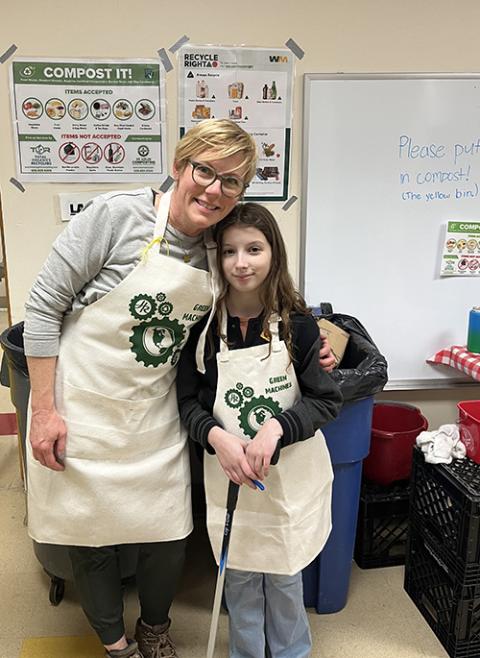
Jamie Hasemeier and her daughter Ruby help sort discarded items into bins during a fish fry at Holy Redeemer Catholic Church, in Webster Groves, Missouri. (Courtesy of Jamie Hasemeier)
Hock agreed, saying the response has been "overwhelmingly positive." He added the experience has been educational for him and many of the Knights who had not considered non-plastic dining options or were unfamiliar with Laudato Si' and other Catholic teachings on creation.
"Our causes and fundraising has not suffered at all," Hock said, noting that compostable materials' costs have dropped as they've become more popular. "That's really a big success story and part of the real reason why our Knights have been more than willing to adopt a lot of these things."
"Protecting the environment isn't just a nice thing to do … but it's also part of our mission as not just Catholics but Christians to protect our God-given gifts," he said.
Similarly dramatic results are visible at Holy Redeemer.
The combination of composting and recycling has reduced the trash collected at its Lenten fish fry to a total of two bags. Likewise, teamwork is making it happen, through students helping sort items into the proper bins and others filling containers with tartar sauce and other condiments to replace small individual packets.
"It takes more effort," Hasemeier said. "But everybody is delighted that we're taking that extra step to reduce the waste."