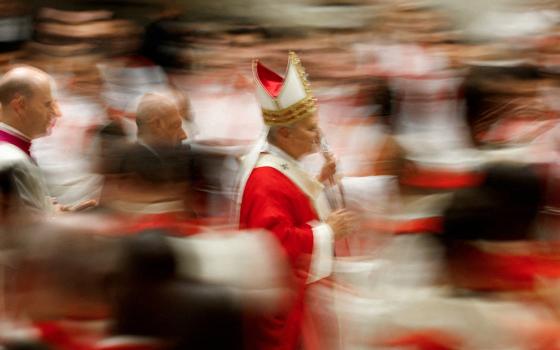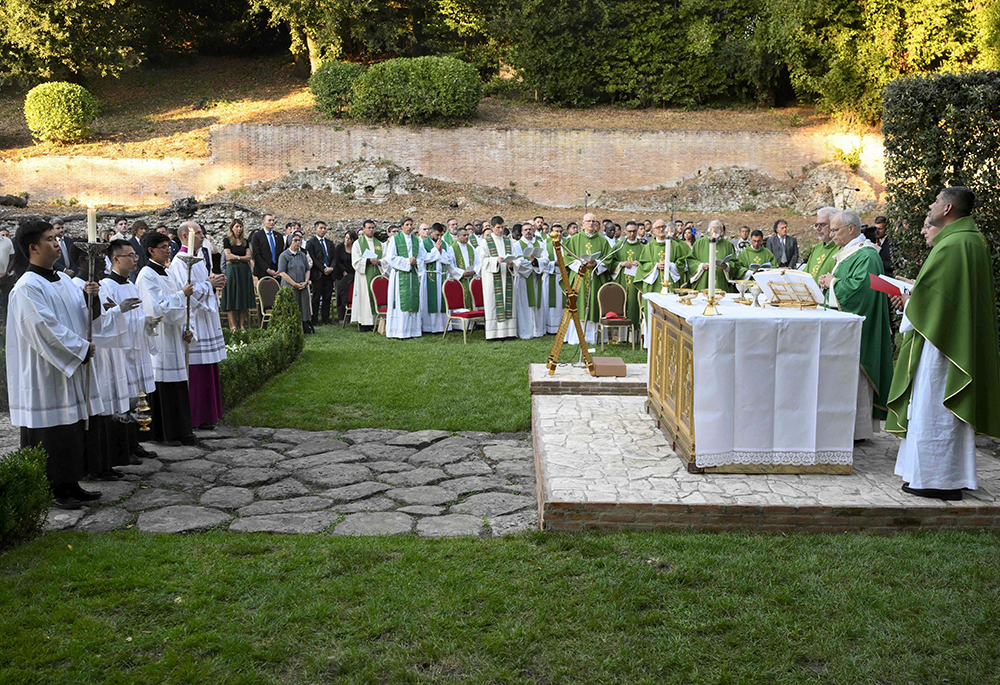
Pope Leo XIV celebrates a Mass at the Borgo Laudato Si' center in Castel Gandolfo, Italy, Sept. 1, 2026, marking the World Day of Prayer for the Care of Creation. (OSV News/Vatican Media/Mario Tomassetti)

Join the Conversation
Send your thoughts to Letters to the Editor. Learn more
Before the discovery of a lump on his lung required a sudden hospital stay, Pope Leo XIV was set to spend Tuesday (Oct. 13) amid budding plants inside the solar-paneled greenhouse of the papal gardens outside Rome.
It was there Leo was scheduled to personally present the inaugural sustainability medal bearing his name. The biennial award, created by Villanova University, the first U.S.-born pope's alma mater, aims to recognize individuals who have made significant contributions in advancing sustainability and ecological responsibility in service of God's creation.
Even in his absence, as he undergoes surgery at Rome's Gemelli Hospital, the Pope Leo Sustainability Medal puts a spotlight not only on its first recipient — Cardinal Michael Czerny — but on Leo himself and how he has situated environmental concern for the church in the first 18 months of his papacy. Casting a shadow over how his efforts are viewed is his predecessor Pope Francis who with his 2015 encyclical "Laudato Si', on Care for Our Common Home" became a global leader and moral conscience on climate change and other socio-environmental issues.
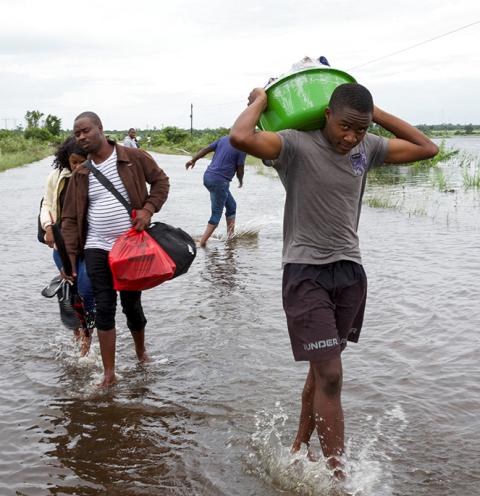
Displaced people carry their belongings through floodwaters in Maputo, Mozambique, Jan. 18, 2026, after weeks of heavy rainfall. (OSV News/Reuters/Amilton Neves)
While Leo has continued many of the ecological initiatives begun under Francis — from sustainable actions to ecological spirituality — he came to the Vatican with his own track record of environmental concern and has since revealed emphases of his own.
"Environmental sustainability and the care of creation are essential commitments to ensure the survival of the human race," Leo said in an address to a theological seminar in September 2025. "They have a direct impact on the organization of our societies and on the possibility of peaceful and cooperative human coexistence."
Integral ecology — the idea that social and ecological issues, and their solutions, are intertwined — is "something he personally has been very interested in, and has been for long before he's been pope," Augustinian Fr. Peter Donohue, Villanova president and a past classmate of the pope, told NCR after the award announcement at the Vatican Sept. 14.
"It's a message he's had for his whole ministry."
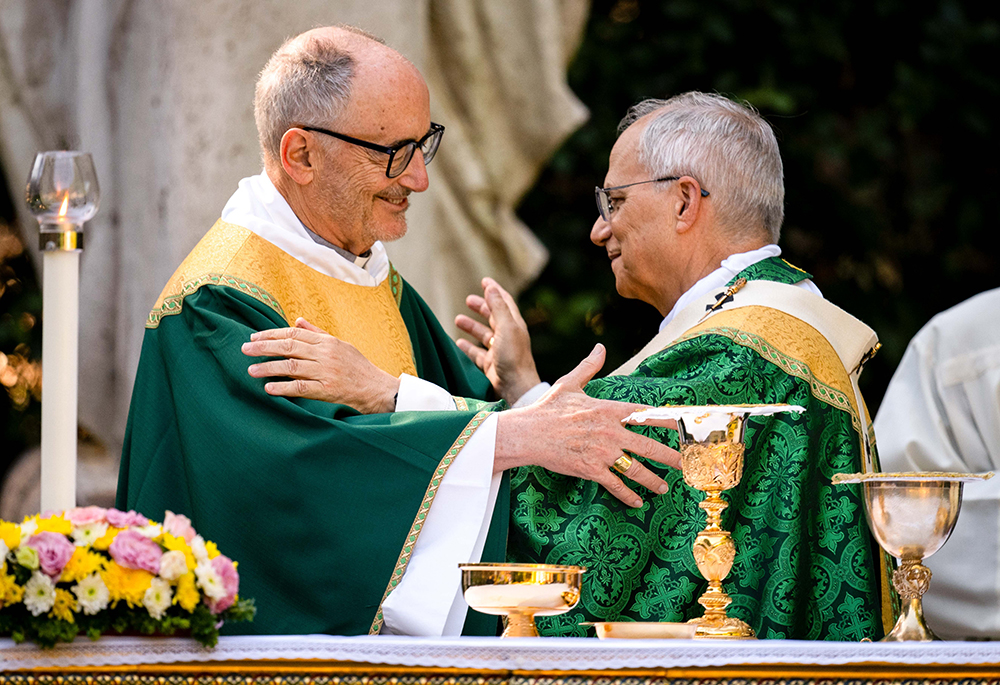
Pope Leo XIV exchanges a sign of peace with Cardinal Michael Czerny, prefect of the Dicastery for Promoting Integral Human Development, while celebrating Mass for the Care of Creation on the grounds of the Borgo Laudato Si' ecology center in Castel Gandolfo, Italy, July 9, 2025. (CNS/Cristian Gennari, pool)
Putting Laudato Si' into practice
Leo's actions as pope on sustainability have spanned from concrete climate measures to advances in theology and practice of the Catholic faith.
In June, he established the Fratello Sole Foundation as a Vatican body to oversee the construction of a 1,000-acre solar farm intended to generate enough electricity to fully power the city-state. Doing so would place Vatican City among the world's first carbon-neutral countries.
"The Foundation represents a sign of hope for the future and an example of how it is possible to reconcile energy production and agriculture while respecting and protecting the environment, in accordance with the principles of environmental sustainability and care for our common home" outlined in church teachings, Leo said at the time.
Advertisement
The massive solar project is significant not just for the greenhouse gas emissions it will avoid but as a visible sign to the world of the church's commitment to addressing climate change, said Nancy Tuchman, retired founding dean of the School for Environmental Sustainability at Loyola University of Chicago who now works with other Jesuit universities to implement sustainability into their curricula and campus footprints.
"[The solar farm] really makes a big statement. And it is kind of putting your money where your mouth is," Tuchman said.
A month earlier, the Pontifical Academy of Theology launched a new observatory to study the impact of emerging digital technologies on energy demands and the socio-environmental exploitation of natural resources.
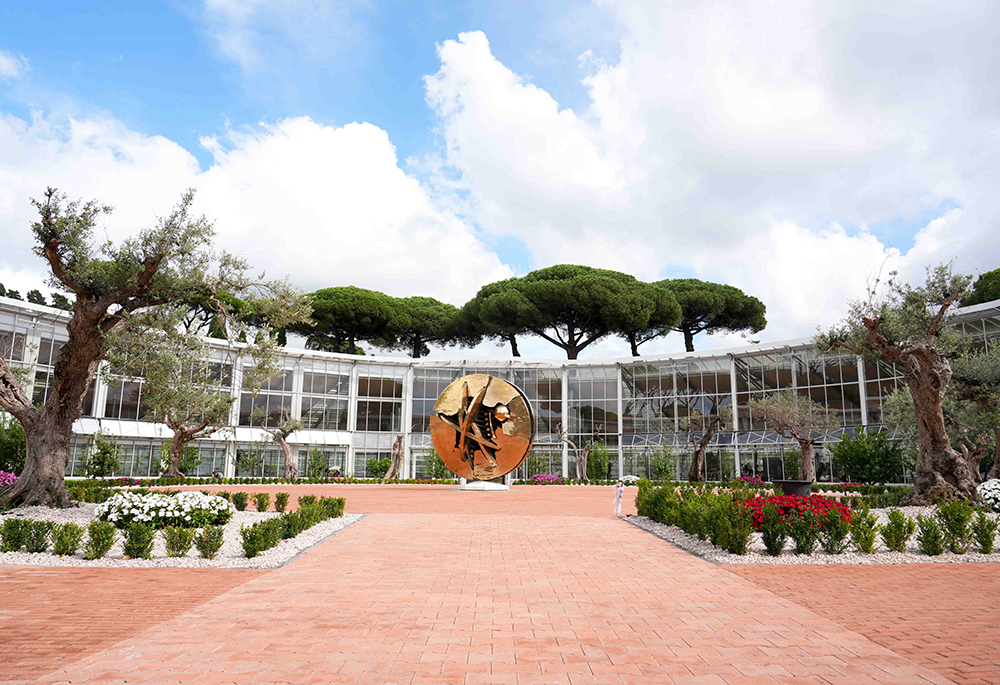
A bronze sculpture titled "Disk in the Form of a Desert Rose" by Italian artist Arnaldo Pomodoro stands at the center of the Borgo Laudato Si’ greenhouse in Castel Gandolfo, Italy, Sept. 2, 2025. (CNS/Lola Gomez)
Other Vatican sustainability projects in the past year have targeted renovations of St. Peter's Basilica and other buildings to improve energy efficiency and reduce carbon footprints. In September 2025, Leo inaugurated Borgo Laudato Si', the integral ecology project in Castel Gandolfo that is hosting the sustainability medal presentation.
It's at Borgo Laudato Si' where Leo also has celebrated the new Mass formulary for the care of creation he added to the Roman Missal last summer.
Each of those initiatives by Leo continued efforts begun under Francis. That shepherding shouldn't diminish Leo's contributions in carrying them forward, said Vincent Miller, a theologian at the University of Dayton who studies the church and ecology. Instead, it reflects the throughline of continuity from pope to pope.
"It's not about someone having a new signature issue that they make solely their own. … His exercise of the papacy has a theology of the papacy within it, which is this belief in the coherence of the tradition," Miller said.
Church observers likened the situation facing Leo with Laudato Si' to that of Pope Paul VI in continuing the Second Vatican Council following the death of Pope John XXIII, or President Lyndon Johnson completing the Apollo mission and continuing space expeditions after John F. Kennedy was assassinated.
Miller also turned to a trope about religious orders where there's often two founders, a first to set the vision and a second who puts it into practice. He highlighted two steps by Leo reflecting his integrator role: establishing the Mass for the care of creation and a document from the Vatican's theological commission, which the pope reviewed before publication, that addressed ecological sin and framed action to care for the environment as both an ethical and theological requirement.
"Those are the moves of someone who understands the significance of how Laudato Si' marked an inflection point in Catholic teaching and continues to want to integrate that within the life and practice of the church," Miller said.
Interconnections in sustainability
Along with actions, Leo has spoken regularly to the environmental threats facing the planet. Often, he has done so by connecting them with other social concerns, whether war or the rapid development of artificial intelligence, which he addressed in his first encyclical Magnifica Humanitas.
"It is essential to develop more sustainable technological solutions that reduce environmental impact and help protect our common home," the pope wrote of the ecological and energy impacts of AI development and data centers.
That integration of issues reflects a Catholic perspective of sustainability, which emphasizes concern for the poor and marginalized along with the environmental dimension, Tuchman said.
"[Leo] doesn't separate the environmental crisis as a separate thing that needs a certain attention, but he does weave it in" to social, political and economic issues, she said. "It isn't a standalone issue. It's part of everything that we have and everything that we do."
In November, Leo issued two messages to world leaders and negotiators at the COP30 United Nations climate summit in Brazil, urging they not lose sight of "the human face of the climate crisis." He also oversaw the update of the Holy See's new climate target under the Paris Agreement.
He has continued the tradition of delivering a message for the World Day of Prayer for the Care of Creation (Sept. 1) that begins the monthlong Season of Creation. He set his September prayer intention for the care of water.
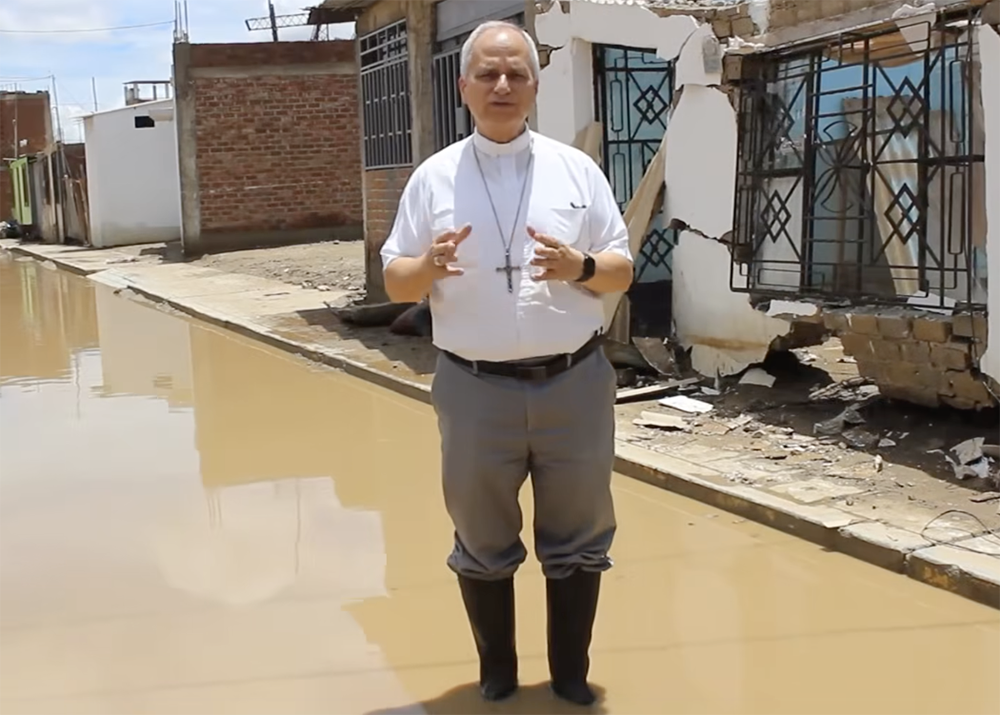
Then-Bishop Robert Prevost, now Pope Leo XIV, stands in floodwaters in the Chiclayo Diocese in the aftermath of heavy rains in northwestern Peru in March 2023, in this screenshot from a video by Caritas Chiclayo (NCR screengrab/Caritas Chiclayo)
Before he was pope, Leo said the time had come to move "from words to action" on climate change. As bishop of Chiclayo, Peru, he supported Catholic-led climate efforts and saw firsthand the impacts of more destructive storms, at one point wading through floodwaters to survey devastated communities.
A high point in Leo's papal messages on the environment came last October, when he addressed a conference in Castel Gandolfo marking a decade since the publication of Laudato Si'. It was there Leo also blessed water from a chunk of melting glacier ice from Greenland.
Lorna Gold, executive director of the Laudato Si' Movement, which co-organized the conference, was seated next to the pope.
"This was something really significant in [him] stepping forward into continuing that legacy of Pope Francis on the church and climate," she said.
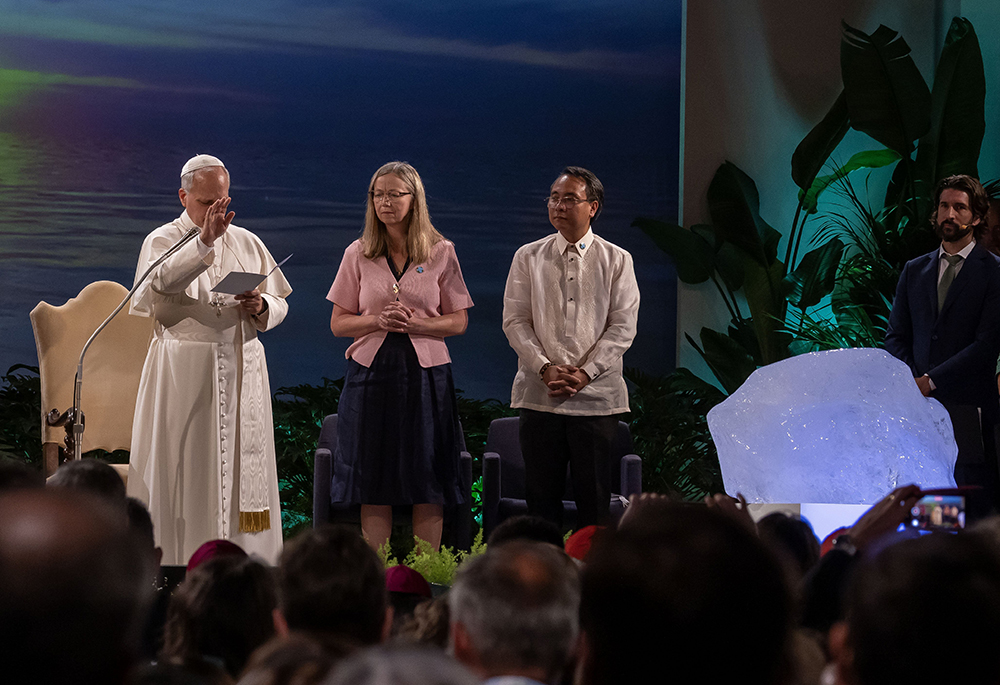
Pope Leo XIV offers a blessing at an international conference celebrating the 10th anniversary of Pope Francis' encyclical "Laudato Si', on Care for Our Common Home," at the Mariapolis Center in Castel Gandolfo, Italy, Oct. 1, 2025. To the right of Leo are Lorna Gold, Laudato Si' Movement executive director, and Yeb Saño, board chair of the movement, which organized the conference. In front of them is a chunk of ice from a glacier in Greenland. (CNS/Pablo Esparza)
Living lab for Laudato Si'
Both the practical and the pastoral approaches to sustainability have been on display at Borgo Laudato Si'.
It is there that Leo has now twice celebrated the new Mass formulary for the care of creation. The set of prayers and readings are seen as holding potential to bring the church's expansive teachings on creation and the environment to more Catholics through the venue where most engage their faith. Even after Laudato Si', parishioners and Catholic environmental groups have regularly expressed frustration that parish priests were not talking or preaching about it.
Among monthly Mass-going Catholics, 67% reported hearing a little or none about climate change in homilies, according to a 2022 Pew Research survey. Roughly one-third of Catholics have heard of Laudato Si', according to another 2023 poll.
Borgo Laudato Si' has become a center of activity for church-led forays into sustainability. The 135-acre project, initially conceived by Francis, provides an incubator to put Laudato Si' principles into practice in areas like regenerative agriculture, irrigation and more for 2,000 students annually.
Along with hosting part of the Villanova conference, it was the scene of the launch of the Global Alliance for Laudato Si' by the University of Notre Dame and the Dicastery for Promoting Integral Human Development to apply Catholic principles toward solutions to ecological crises, including climate change.
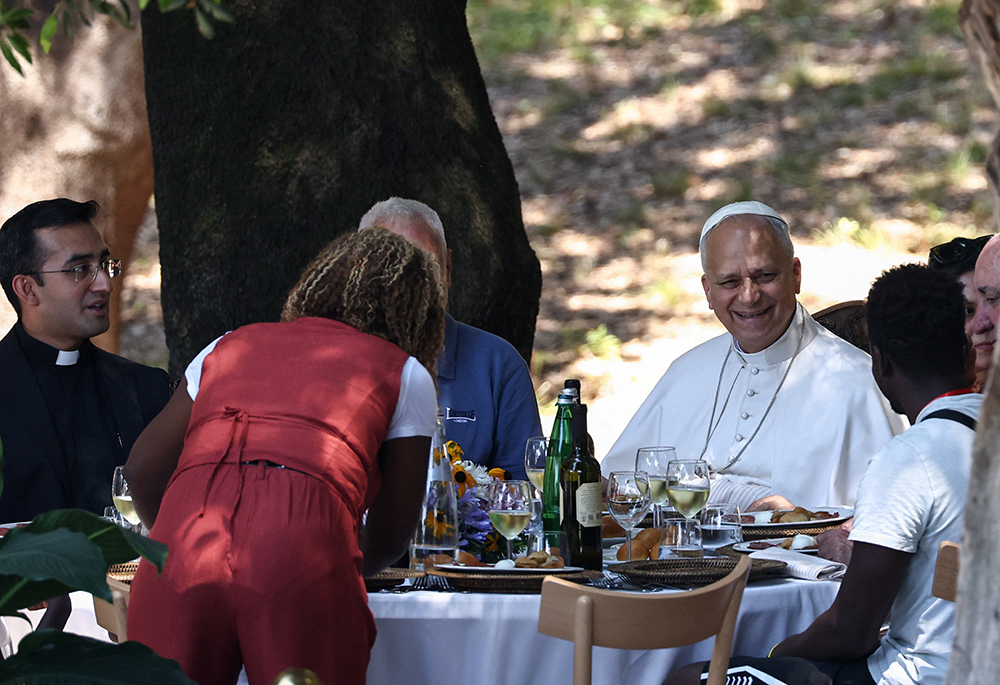
Pope Leo XIV has lunch with vulnerable people from the Diocese of Rome at Borgo Laudato Si, in the pontifical gardens of Castel Gandolfo, Italy, July 11, 2026. (OSV News/Reuters/Matteo Minnella)
Leo has visited Borgo Laudato Si' during his regular respites to Castel Gandolfo, often speaking with reporters from its grounds. Putting a spotlight on the project, even with just his appearance, can be incredibly crucial to its success, Tuchman said.
"That really lends credibility that no other person can really bring," she said.
In June, Leo addressed the first gathering of the "Borgo Dialogues," an invitation-only forum for global leaders across sectors to develop practical blueprints to solving world challenges, including climate change.
A second Borgo Dialogues was held Sept. 20-23 on the sidelines of the U.N. General Assembly in New York. The group's work, led by Cardinal Fabio Baggio, director general of the Laudato Si' Center for Higher Education, will be presented next year at the World Economic Forum in Davos, Switzerland.
That multi-sector approach reflects the holistic vision of sustainability — combining care for the environment, social justice, concern for vulnerable populations and responsible stewardship of economic and natural resources — that Villanova's Pope Leo medal seeks to honor.
It also reflects Leo's own views on integral ecology and sustainability, church observers said, and how he intends to continue and deepen the work of Laudato Si' as his papacy progresses.
"All of these messages are really important," Gold said of Leo's ecological efforts. "And they send a very clear signal that the legacy of Pope Francis on these issues lives on, but also that Pope Leo is making these his own."