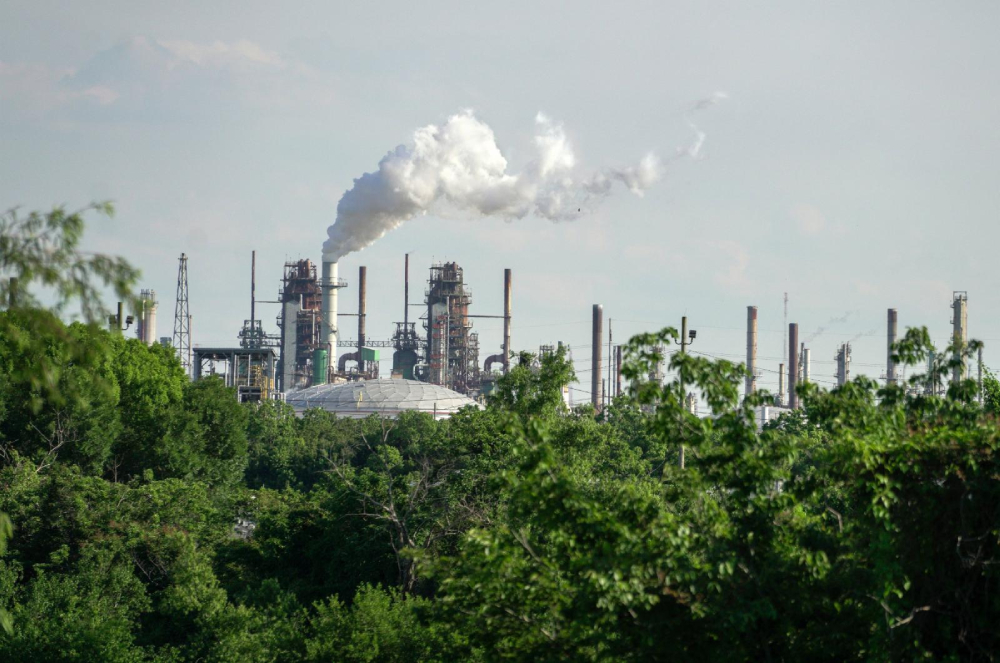
A file photo shows smoke billowing from the stacks of the ExxonMobil Baton Rouge Refinery in Baton Rouge, La. (OSV News/Reuters/Kathleen Flynn)

Join the Conversation
Send your thoughts to Letters to the Editor. Learn more
The vast majority of young adults in the United States worry about climate change but have declining faith in government and institutions to effectively act on sustainability issues, according to a new poll from Sacred Heart University.
The survey, conducted in March by the Laudato Si' Office of Sustainability and Social Justice, found nearly 70% of young people said they were somewhat (40.6%) or very worried (27.9%) about climate change. Fifty-five percent expressed experiencing "eco-anxiety," or psychological distress over climate change impacting their daily lives.
Asked their feelings on climate change, the top responses were anxious (39%), frustrated (31%) and afraid (26%). Slightly more said they were hopeless (22.5%) than hopeful (21.3%).
While climate concern remained steady with survey results from 2025, the level of eco-anxiety dropped by 8 percentage points, possibly due to the issue being less top-of-mind, Sacred Heart researchers said in a report on the survey results.
"Climate concern is widespread among U.S. youth, but the climate experience is defined by anxiety, not intensity," they said.

(Unsplash/Joice Kelly)
The Laudato Si' Office at the Catholic school in Fairfield, Connecticut, worked with GreatBlue Research to poll online 1,500 U.S. residents between the ages of 15 and 29 from March 5-12. The survey carries a margin of error of plus or minus 2.4 percentage points.
Nearly two-thirds of respondents ranked addressing sustainability and social justice as important to them. More than 9-in-10 said it was important for colleges and universities to teach on both subjects, as well as develop skills in students to act on them.
In the U.S., Catholic schools and universities, including Sacred Heart, have been among the most active participants in the Vatican's Laudato Si' Action Platform, a global initiative that provides a blueprint for Catholic individuals and organizations to act on church teachings on the environment, as articulated by Pope Francis in his 2015 encyclical "Laudato Si', on Care for Our Common Home."
In the first year of his papacy, Pope Leo XIV, the first successor to St. Peter from the U.S., has continued Francis' emphasis on climate change and environmental crises, saying at one point "The challenges identified in Laudato Si’ are in fact even more relevant today than they were ten years ago" and require an ecological and spiritual conversion.
Overall, the Sacred Heart survey found limited change among students' views from a poll it conducted in 2025. Some of the sharpest declines came in young adults' confidence in their ability to act on matters of sustainability and social justice (down 7 percentage points to 61%) and their feelings of personal responsibility to act on such issues (down 6 percentage points to 65%).
Young adults also expressed declining levels of trust in institutions to effectively address sustainability and social justice issues.
Each of the 11 groups listed by the survey received lower trust ratings in 2026 than 2025, with the steepest drops for the federal government (42.1%, down 14.4 percentage points), large corporations (36.5%, down 11.4 percentage points) and the country's wealthy elite (33.2%, down 11.5 percentage points).
Colleges (60%) ranked highest in trust, and were joined by nonprofit organizations, faith-based charities and other charitable foundations as the only institutions garnering majority trust levels. For organized religion, trust was 44%, down nearly 7 percentage points from last year.
The U.S. Environmental Protection Agency's sign is seen on the podium at EPA headquarters in Washington July 11, 2018. (OSV News/Reuters/Ting Shen)
The survey was conducted more than a year into the second term of the Trump administration, which has aggressively cut federal spending on climate change and worked to weaken or eliminate many regulations aimed at limiting greenhouse gas emissions that fuel climate change and other pollutants that harm human life and ecosystems. At the same time, numerous companies have scaled back or walked away from past pledges to reduce their heat-trapping emissions.
U.S. emissions rose 2.4% in 2025, according to the Rhodium Group. Each of the last 11 years rank as the hottest on record.
The survey found young adults concerned about climate change across the political spectrum, with majorities of Democrats (80.5%), Republicans (58.4%) and independents (67.1%) saying they are somewhat or very worried. Differences reflecting surveys of the broader U.S. public emerged among those who are very worried, with the percentage of Democrats (43.1%) nearly equaling Republicans (18%) and independents (25.2%) combined.
The Sacred Heart survey also looked at how the country's young adults receive information. Two-thirds cited social media and half answered people they follow on social media. Family (43%), friends (41%), national news outlets (26.5%) and local news (22.5%) rounded out the top six information sources.
Despite social media leading as an information source, trust in that information lags. Just over half placed medium or high trust in it as an information source. Family (72%) and friends (71%) led, followed by people young adults follow on social media platforms (61%) and colleges (59%). Majorities of respondents held the same trust levels in each of national news outlets, local news and public radio and TV.
Advertisement
As with institutions and sustainability action, trust in each of the 12 information categories declined from 2025 to 2026.
Asked what would motivate them to take actions on sustainability and social justice, more than four-in-10 listed personal experiences of concern for their community's well-being. Fewer listed religious or moral values (29%) or political views (25%) as motivating factors.
As to the kinds of actions they are likely to take, young adults gravitated toward more passive, lower-barrier activities like completing online surveys on issues (41%), signing petitions (30%) and following candidates on social media (24%). Less than 18% said they would attend a protest or rally, and fewer said they would join a boycott or display a political sign.
"These findings reinforce what we’re hearing directly from young people: they care deeply, but they’re looking for clearer pathways to make a difference," Marylena Mantas-Kourounis, assistant professor of political science and global affairs, said in a press release about the survey.